Gov’t backs BOSAG to position Ghana as a premier BPO & GBS hub and deliver 100,000 jobs
Date: 2026-05-19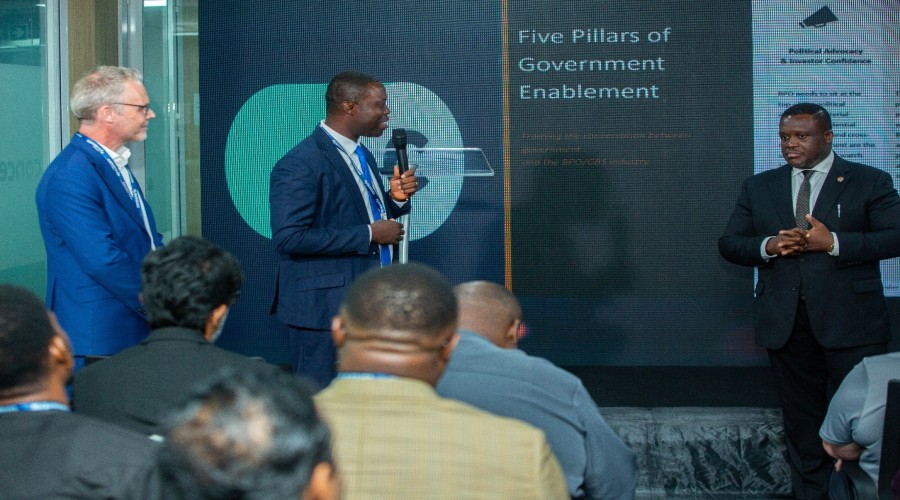
By: Nana Appiah Acquaye
The Business
Outsourcing Services Association Ghana (BOSAG) has called for stronger
government backing to accelerate the growth of Ghana’s Business Process
Outsourcing (BPO) and Global Business Services (GBS) sector, as part of efforts
to position the country as a competitive global outsourcing destination and
deliver 100,000 new jobs for young Ghanaians.
The call was
made at the maiden High‑Level Government–Industry Roundtable organised by
BOSAG, in partnership with the Tony Blair Institute for Global Change (TBI),
and hosted by Concentrix, the global technology and services leader and a
Fortune 500 company, under the theme: “Positioning Ghana as a Competitive
Global BPO/GBS Destination: From Strategy to Execution.”

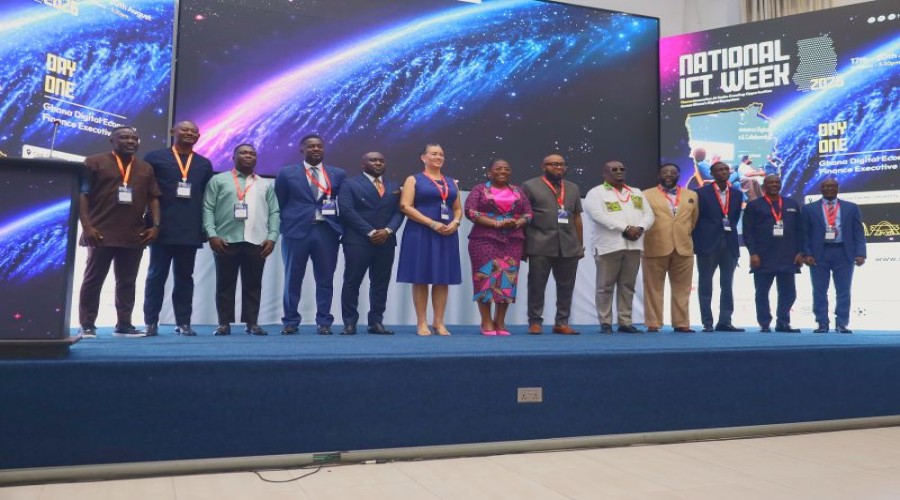
Mr. Ryan Keilloh, Country Manager of
Concentrix Ghana and Senior Operations Director, David Gowu, CEO of BOSAG, Mr
Kojo Hayford, Board Chair of BOSAG, Hon. Samuel Nartey George, Minister for
Communication, Digital Technology and Innovation and other key stakeholders in
a group photo at the event
Opening the
Roundtable, the Board Chair of BOSAG, Mr. Kojo Hayford, who is also the Founder
and Chief Executive Officer of eSAL, stressed the critical role of government
in creating an enabling policy, skills, and infrastructure environment to
unlock the full potential of the GBS sector. He emphasised that deliberate
government leadership and coordination are essential to building investor
confidence and scaling sustainable job creation at pace.

Minister for Communication, Digital Technology and Innovations, Samuel Nartey George delivering his remarks at the High-Level Government–Industry Roundtable on Ghana’s BPO/GBS Sector event
The engagement
brought together senior government officials, industry leaders, and development
partners to discuss policy coordination, investor confidence, skills
development, infrastructure enablement, and market access required to
strengthen Ghana’s outsourcing ecosystem.
In a
presentation to the Hon. Minister for Communication, Digital Technology and
Innovations and other key stakeholders, Mr. Ryan Keilloh, Country Manager of
Concentrix Ghana and Senior Operations Director, highlighted how Concentrix,
which operates in over 70 countries globally, has already employed more than
1,200 young people in Ghana, with over 130 employees promoted into leadership
positions this year alone.

Board Chair of BOSAG, Mr. Kojo
Hayford delivers a presentation on the purpose and objectives of the Roundtable
discussion on Ghana's BPO/GBS Sector
Mr Keilloh
further outlined the ambition of the organization to grow its presence in Ghana
over time, with plans to continue creating employment opportunities for young
people as demand increases, reinforcing Ghana’s position as a competitive
location for global business services delivery.
Speaking at the
Roundtable, Nana Aba Edzie, supported by Daniel Busscher, Senior Advisor for
Digital and Technology Transformation at the Tony Blair Institute for Global
Change, noted that discussions underscored government enablement as essential
to unlocking the sector’s full potential. According to them, deliberations
crystallised around five priority areas requiring urgent and coordinated
action: political advocacy and investor confidence; skills alignment; demand
generation; infrastructure and real estate repurposing; and market access and
enabling reforms.
They stressed
that stronger political ownership would send a clear signal to investors that
Ghana is committed to supporting the long‑term growth of the BPO and GBS
sector. They also called for stronger collaboration between government and
industry under the One Million Coders Programme to establish a clear training‑to‑employment
pipeline capable of linking graduates directly to opportunities within the
outsourcing industry.

Nana Aba Edzie of the Tony Blair Institute for Global Change leads a discussion on policy and execution at the High-Level Government–Industry Roundtable on Ghana’s BPO/GBS Sector event
The Minister
for Communication, Digital Technology and Innovations, Hon. Samuel Nartey
George, reaffirmed government’s commitment to supporting the sector, describing
BOSAG as a “critical tool” in Ghana’s digital transformation agenda. He stated
that the Ministry would work closely with agencies including the Ministry of
Trade, Ministry of Foreign Affairs, and the Ghana Investment Promotion Centre
(GIPC) to strengthen investor attraction and market access initiatives.
The Minister
disclosed that the One Million Coders Programme has officially commenced across
more than 150 training centres nationwide, stressing that government’s focus
goes beyond training numbers to ensuring clear employment outcomes. “For me,
the One Million Coders is not just a political tool. It goes beyond saying we
have trained one million people. The real question is what happens to those
people after the training,” he said.
Hon. Samuel
Nartey George welcomed BOSAG’s ambition to facilitate 100,000 new jobs and
challenged the association and industry players to clearly articulate the
specific skill sets required by outsourcing companies so government could
tailor training programmes to meet market demand.

Key Stakeholders present at the High-Level Government–Industry Roundtable on Ghana’s BPO/GBS Sector event in a group photo
He also
encouraged outsourcing firms to expand operations beyond Accra into regions
where lower real estate costs and multilingual talent could support diversified
service delivery. The Minister further indicated government’s readiness to
repurpose state‑owned properties for BPO and GBS operations where concrete
demand exists.
Chief Executive
Officer of BOSAG, David Gowu, noted that Africa currently accounts for only 2.8
percent of the global outsourcing industry, despite the sector being valued at
approximately US$1.5 trillion globally. He observed that while countries such as
South Africa, Egypt, Morocco, and Tunisia are aggressively promoting themselves
as outsourcing destinations, Ghana continues to grow largely through organic
expansion.
Mr. Gowu
revealed that global firms including Teleperformance and Concentrix have
together employed over 2,500 full‑time staff in Ghana, while the broader BPO
and GBS sector has created employment for more than 20,000 young people
locally.

Minister for Communication, Digital
Technology and Innovations, Samuel Nartey George receives a portrait painting
at the High-Level Government–Industry Roundtable on Ghana’s BPO/GBS Sector
event
According to
him, the sector has strong potential to absorb large numbers of unemployed
graduates, generate foreign exchange earnings, and contribute to economic
growth through tax revenues and auxiliary services.
“We are
producing more graduates than the economy can absorb. We want companies to come
to Ghana, set up here, employ our people here, and allow them to build careers
while contributing meaningfully to the economy,” he added.
Rounding up the
High‑Level Government–Industry Roundtable, Madam Mavis Ampah‑Sintim‑Misa, Board
Chair of the National Communications Authority (NCA) and a Board Member of
BOSAG, reminded participants that Ghana has reached a stage in the BPO and GBS
industry where it is no longer emerging, but has emerged. She urged more local
and international operators, buyers, and investors to take advantage of the
opportunities Ghana offers.
She further
emphasised the need for Ghana to deliberately package and communicate its
positive positioning within the West African region, noting that the country’s
strong fundamentals are sometimes overshadowed by negative external
perceptions. According to her, a clear and confident national narrative is
critical to attracting investment and sustaining momentum in the sector.