By: Nana
Appiah Acquaye
Senegalese space and
technology expert Maram Kaire has been appointed Associate Editor of the first
Editorial Board of the new international scientific journal Deep Space
Exploration, strengthening Senegal’s representation in global discussions
on space science and future exploration.
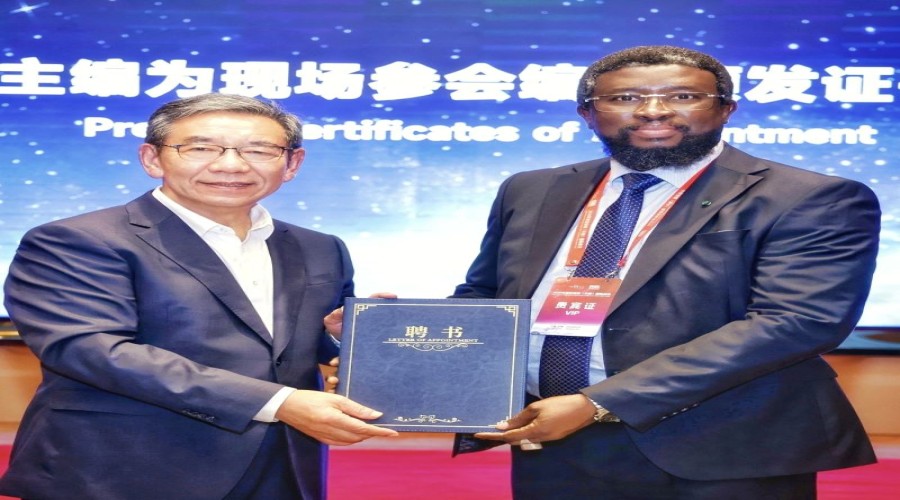
Kaire, CEO of Senegalese
Agency for Space Studies, announced the appointment following the official
launch of the journal on September 3, 2026, in Hefei, China. The journal’s
inaugural editorial board brings together 60 scientists and experts from
several countries and leading scientific and space institutions.
At the invitation of the
International Deep Space Exploration Association (IDSEA), Kaire will represent
Senegal through the Senegalese Agency for Space Studies on the editorial board.
The board includes experts
from China, France, Italy, the United States, Spain, South Africa, Argentina,
Mexico, Singapore, the United Arab Emirates and other countries, as well as
representatives from major scientific and space institutions.
These include the China
National Space Administration, the Deep Space Exploration Laboratory, the
Chinese Academy of Sciences, the China Academy of Space Technology, the Harbin
Institute of Technology and the South African Radio Astronomy Observatory.
Kaire’s appointment follows his
recent integration into Seraphim Space’s Global Advisory Board on the Future of
the Space Sector, giving his two international platforms focused on the
strategic development of the global space industry.
He noted that the
appointments reinforce the need for Africa to be more strongly represented in
the spaces where the future of the space sector and emerging scientific
frontiers are being shaped.
According to Kaire, Africa’s
role must extend beyond the use of space technologies to include contributing
to scientific knowledge, developing skills and technologies, and participating
actively in major international scientific cooperation.
He said he views the new
responsibility as an opportunity to help open international scientific and
space networks further to Senegalese and African researchers, engineers,
students and young scientists.
Kaire said the progress
achieved so far should encourage the continent, while the work that remains
requires greater commitment to excellence, knowledge, cooperation and sustained
effort.
“Africa has its place in the
great scientific and space adventures of our time,” he said, adding that the
continent must build that place through excellence, work, knowledge and
cooperation.