By: Nana
Appiah Acquaye
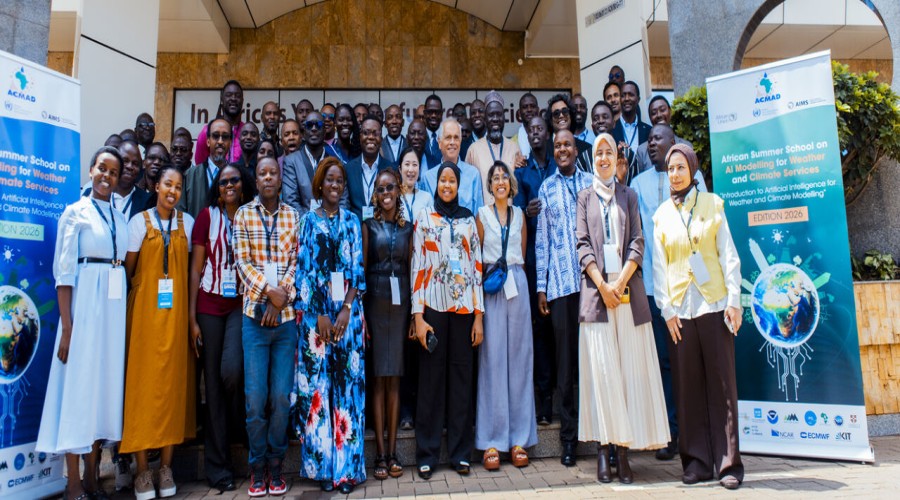
The African Centre of
Meteorological Applications for Development (ACMAD), the World Meteorological
Organization (WMO) and the African Institute for Mathematical Sciences (AIMS)
have launched the African Summer School on Artificial Intelligence for Weather
and Climate Modelling in Kigali, Rwanda, to strengthen the use of artificial
intelligence in weather forecasting and climate services across Africa.
The programme, taking place
from October 19 to 23, 2026, brings together African scientists,
meteorologists, researchers and international experts to advance AI-enabled
weather and climate services across the continent.
Speaking at the opening
ceremony, Dr. Ousmane Ndiaye, Director General of ACMAD, underscored the
importance of harnessing artificial intelligence and African scientific
expertise to advance weather and climate services.
“Our best adaptation
strategy is early warning,” he said, stressing the need to ensure that relevant
and actionable climate information reaches people in a form they can understand
and use to make informed decisions.
Prof. Sam Yala, President of
the AIMS Network, highlighted the potential of artificial intelligence to
strengthen regional forecasting and early warning systems.
He said AI tools could help
analyse complex datasets, improve forecasts, support downscaling and bias
correction, and enhance the monitoring of extreme events.
Over the five-day programme,
participants will engage in expert-led sessions, hands-on practical exercises
and collaborative projects covering AI-based forecasting, climate data
processing, model evaluation, and applications for extreme-event monitoring and
early warning services.
The Summer School aims to
strengthen local capacity, foster innovation and advance the development of
AI-enabled weather and climate services across Africa by bringing together
scientific expertise and encouraging collaboration among researchers and practitioners.