Africa CDC and Africa Frontline First sign agreement to scale community health workforce across Africa
Date: 2026-04-28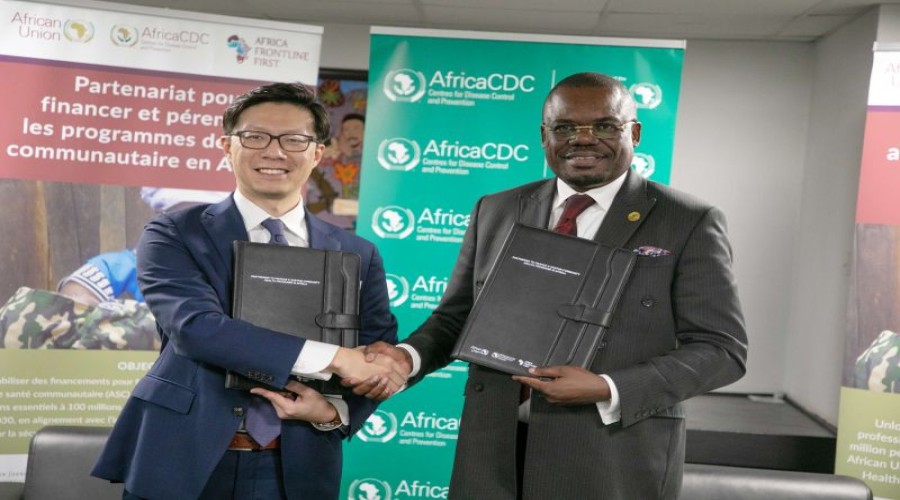
By: Nana Appiah Acquaye
The
Africa Centres for Disease Control and Prevention and Africa Frontline First
have signed a Memorandum of Understanding aimed at accelerating the deployment
of 200,000 Community Health Workers across the continent.
The
agreement was signed in Nairobi, Kenya, during the World Health Summit Regional
Meeting 2026, marking a renewed commitment to strengthening Africa’s community
health systems and advancing primary healthcare delivery.
The
partnership builds on collaboration efforts between 2023 and 2025 and outlines
a joint action plan for 2026–2028. It combines Africa Frontline First’s
financing and technical support with Africa CDC’s leadership role in
coordinating public health initiatives across African Union member states.

The
initiative supports the African Union’s target of deploying 2 million
polyvalent Community Health Workers by 2030, with a focus on integrating these
workers into national health systems and strengthening long-term health
resilience.
Africa
CDC Director General Jean Kaseya said the partnership is critical to
accelerating progress toward Africa’s health security and sovereignty agenda,
emphasising the need to move from commitments to measurable outcomes in
community health expansion.
Africa Frontline First Co-Executive Director Nan Chen highlighted the importance of sustainable financing and system durability, noting that community health systems must be structured to withstand shifts in donor priorities and ensure long-term resilience.
Between
2023 and 2025, the collaboration contributed to the mobilisation of over
106,000 Community Health Workers and supported more than 900 million US dollars
in financing commitments for community health programmes. It also advanced
digital systems, surveillance tools and integrated health data platforms to
improve service delivery and accountability.

The
new agreement prioritises scaling deployment, increasing domestic financing,
strengthening training and certification systems, integrating community health
workers into primary healthcare structures, and improving programme evaluation
mechanisms.
Officials
said the partnership reflects a broader shift toward integrated and
system-driven community health models designed to improve access to care,
particularly in underserved and hard-to-reach communities across Africa.