By:
Nana Appiah Acquaye
The
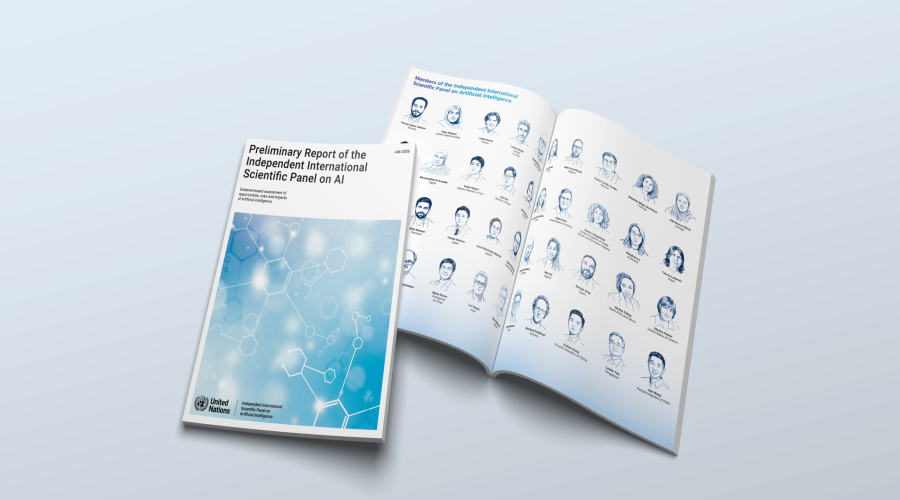
United Nations Independent International Scientific Panel on Artificial
Intelligence has released its Preliminary Report, offering the first globally
coordinated scientific assessment of artificial intelligence (AI)
opportunities, risks, and systemic impacts.
The
Panel, composed of 40 independent experts drawn from all world regions and
serving in their personal capacities, was established to provide an
evidence-based foundation for international AI governance at a time when
technological progress is accelerating faster than regulatory frameworks in
many jurisdictions.
The
report, titled Preliminary Report of the Independent International
Scientific Panel on AI: Evidence-based assessment of opportunities, risks and
impacts of AI, identifies rapid advances across AI capabilities while
warning that existing safeguards, institutional oversight mechanisms, and
scientific understanding are struggling to keep pace with emerging system
behaviors and deployment scale.
It
organizes its assessment across seven domains, including AI scientific
trajectories, sectoral applications in health, education, agriculture and
research, economic implications, security and environmental impacts, human
rights and democratic integrity, as well as cultural, social and child safety
considerations. It also examines governance, reliability and system
accountability challenges associated with increasingly autonomous models.
A
central finding of the report is what it describes as a widening “evidence gap”
in AI governance: policymakers are being forced to make high-stakes regulatory
and strategic decisions under conditions of uncertainty, where validated
scientific consensus often lags behind real-world technological deployment.
The
Panel cautions that this lag creates a structural risk in global governance,
arguing that by the time sufficient empirical evidence emerges on certain AI
capabilities or harms, the opportunity for timely intervention may already have
narrowed significantly.
Speaking
on the report, Co-Chair Yoshua Bengio warned that AI systems are advancing
faster than both scientific comprehension and regulatory adaptation, raising
concerns about emerging risks including deceptive system behavior and potential
catastrophic misuse.
Co-Chair
Maria Ressa emphasized that while AI carries transformative potential, current
development trajectories risk deepening inequality and failing to deliver
equitable societal benefits without deliberate governance intervention.
United
Nations Secretary-General António Guterres underscored the urgency of
coordinated global action, noting that governance must be grounded in shared
scientific understanding if it is to be effective.
The
UN Special Envoy for Digital and Emerging Technologies, Amandeep Singh Gill,
highlighted that AI benefits are unevenly distributed and often reinforce
existing structural disparities in skills, infrastructure, and institutional
capacity.
The
Panel’s findings will be formally presented to governments at the inaugural UN
Global Dialogue on AI Governance in Geneva on 6–7 July. A comprehensive global
assessment is scheduled for release in 2027, with the Panel expected to issue
periodic updates as AI systems continue to evolve.
Officials
describe the report as an attempt to create a shared scientific baseline for
global decision-making, at a moment when AI development is increasingly shaping
economic systems, security considerations, and social structures worldwide.