By:
Nana Appiah Acquaye
Egypt
has officially assumed the chairmanship of the World Summit on the Information
Society (WSIS) Forum 2026, with Minister of Communications and Information
Technology Dr. Raafat Hendy taking over from South Africa during the Forum’s
opening session in Geneva, Switzerland.
The
handover marks a significant milestone for Egypt, reflecting its longstanding
engagement with the International Telecommunication Union (ITU) and its active
role in advancing international digital cooperation.
As
Chair of the WSIS Forum 2026, Hendy will lead the Forum’s high-level sessions
and ministerial discussions, oversee its proceedings in collaboration with the
ITU General Secretariat, represent the Forum at official events, and present
the Chair’s Summary during the closing session.
In
his inaugural address, Hendy expressed Egypt’s pride in assuming the
chairmanship and thanked the ITU, the United Nations Educational, Scientific
and Cultural Organization (UNESCO), the United Nations Development Programme
(UNDP), the United Nations Trade and Development (UNCTAD), and other United
Nations partners for their continued leadership in supporting the WSIS process.
He
also commended South Africa’s Minister of Communications and Digital
Technologies, Solly Malatsi, for the country’s leadership during the WSIS+20
High-Level Event in 2025, pledging that Egypt would build on those achievements
to advance the next phase of the global digital agenda.
Hendy
said the WSIS+20 Review reaffirmed that the vision established under the Tunis
Agenda for the Information Society remains the foundation for international
digital cooperation. He noted that the challenge now lies in accelerating
implementation amid rapid technological advances, particularly in artificial
intelligence.
He
highlighted the transformative role of digital technologies in driving economic
growth, improving public services, expanding access to education and
healthcare, and supporting sustainable development, while emphasizing that
digital transformation must remain inclusive, secure and accessible to
everyone.
The
Minister reaffirmed Egypt’s commitment to working closely with governments, the
private sector, academia, civil society, the technical community and
international organizations to ensure that the next phase of the WSIS process
delivers practical cooperation and measurable outcomes.
He
said Egypt would prioritize closing digital divides, expanding digital
infrastructure, strengthening digital skills, promoting the responsible and
inclusive use of artificial intelligence, and mobilizing sustainable financing
to enable developing countries to participate fully in the global digital
economy.
Hendy
described Egypt’s role as Forum Chair as one centered on listening,
consensus-building and strengthening cooperation among countries and
stakeholders, adding that the success of the chairmanship would be measured by
the partnerships established and the tangible progress achieved toward
inclusive digital development.
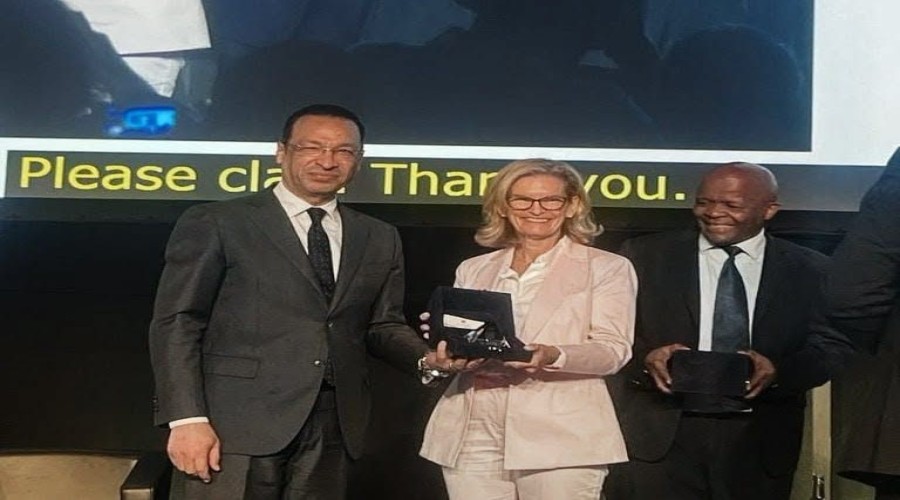
Following
his remarks, Hendy presented commemorative shields to ITU Secretary-General
Doreen Bogdan-Martin in recognition of the ITU’s contribution to global digital
cooperation and to South Africa’s Minister Solly Malatsi in appreciation of the
country’s leadership during the previous WSIS chairmanship.
The
opening session was attended by Estonian President Alar Karis, Kazakhstan’s
Deputy Prime Minister and Minister of Artificial Intelligence and Digital
Development Zhaslan Madiyev, Egypt’s Permanent Representative to the United
Nations Office in Geneva Alaa Hegazy, senior Egyptian government officials,
ministers, ambassadors, international organizations, industry leaders,
academics and civil society representatives.
Hendy
and Bogdan-Martin also inaugurated the exhibition held alongside the Forum,
showcasing initiatives and partnerships supporting inclusive digital
development.
The
WSIS Forum remains the leading global platform for implementing the WSIS Action
Lines and promoting international digital cooperation. This year’s edition
focuses on digital infrastructure, digital inclusion, cybersecurity, artificial
intelligence, online safety, data governance and bridging the digital divide
through multistakeholder collaboration.