By: Nana
Appiah Acquaye
Smart Africa has been urged
to transform its continental network into a powerful commercial distribution
engine capable of helping African technology companies expand across borders
and become global competitors.
Henri Nyakarundi, Founder
and Chief Executive Officer of ARED Group, argues that the alliance may be
missing a major opportunity despite already possessing many of the
relationships and institutional connections African technology companies need
to scale.
Smart Africa brings together
governments, policymakers, regulators and technology stakeholders across the
continent and has set an ambition of creating a Single African Digital Market
by 2030. Yet Nyakarundi questions why this network is not being more systematically
used to help African technology companies access new markets, customers,
procurement opportunities and commercial partners.
“Why isn’t Smart Africa one
of the most powerful distribution engines for African technology companies?”
Nyakarundi asked.
According to him, the
alliance has direct relationships with ministers, regulators and policymakers,
while global technology companies are visibly embedded within its ecosystem.
While he acknowledged the importance of global technology to Africa’s digital
development, he questioned the availability of similar structures designed to
help African innovators scale across the continent.
Nyakarundi suggested that
Smart Africa could help build a structured pathway for African technology
companies seeking to expand into new markets.
“If I build technology in
Rwanda, why can’t this network systematically help me find a distributor in
Ghana, a government opportunity in Kenya, an integrator in Senegal or a
customer in Côte d’Ivoire?” he said.
He argued that such
capabilities should represent the real power of a Single African Digital
Market, allowing technology companies to access qualified local partners,
regulators, customers and procurement opportunities across member countries.
Nyakarundi also raised
questions about access to the organisation, noting that membership at the
highest levels can provide access to meetings involving Heads of State and ICT
ministers, while startups do not receive the same level of access.
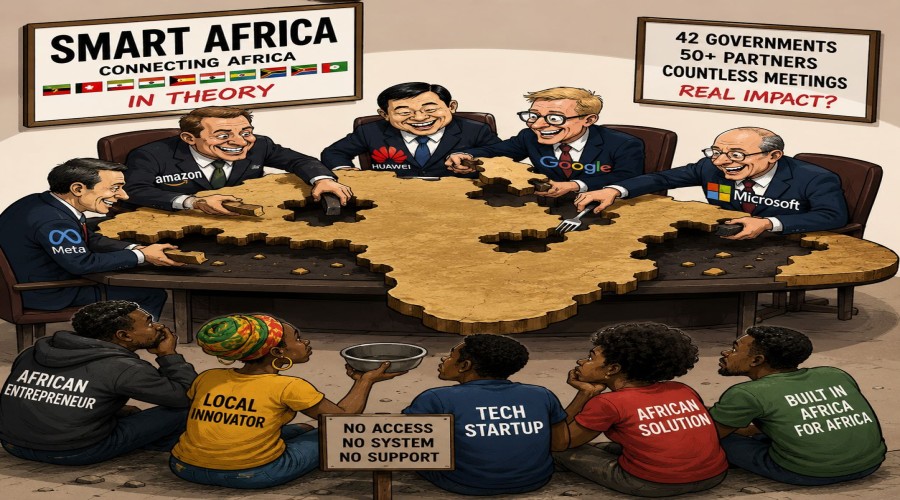
“The organization created to
accelerate Africa’s digital transformation risks becoming easier for
established global corporations to navigate than for the African innovators it
should be helping become global companies,” he said.
Smart Africa has recognised
part of this challenge through its new SANIA initiative, which is intended to
connect entrepreneurs, investors, accelerators and ecosystem organisations
across borders. Nyakarundi described the initiative as progress but argued that
networking alone would not be sufficient.
African entrepreneurs, he
said, need more than another ecosystem. They need distribution, customers,
contracts, procurement access, verified local partners, integrators and
cross-border government introductions.
Nyakarundi proposed that
Smart Africa could encourage its member governments to actively identify
qualified African technology solutions when procuring digital infrastructure.
He also called for a structured system that would support African technology companies
entering other member countries by connecting them with local partners and
relevant market opportunities.
Such an approach, he argued,
could help African companies scale beyond their domestic markets and strengthen
the continent’s technology ecosystem without excluding international firms.
“Africa needs global
technology,” he said, while maintaining that a continental digital alliance
should also create stronger pathways for African innovation to move across
African markets.
For Nyakarundi, the central
challenge is whether Smart Africa can evolve beyond being a platform for
dialogue and networking into an institution that actively supports commercial
expansion and cross-border market access for African technology companies.
“If Africa builds a
42-country digital alliance and that alliance becomes a better gateway into
Africa for global technology companies than out of Africa for African
technology companies, then something is fundamentally backwards,” he said.
He believes the foundations
already exist, with governments, institutions and networks already connected
through the alliance.
“We already built the
network. We already have the governments. We already have the institutions. Now
turn it into a commercial weapon for African innovation,” Nyakarundi said.
He added that Africa does
not need another platform where entrepreneurs can simply meet, but a vehicle
capable of helping African technology companies grow into African
multinationals and eventually global companies.
“That is what Smart Africa
could become,” he said.