By: Nana
Appiah Acqaye
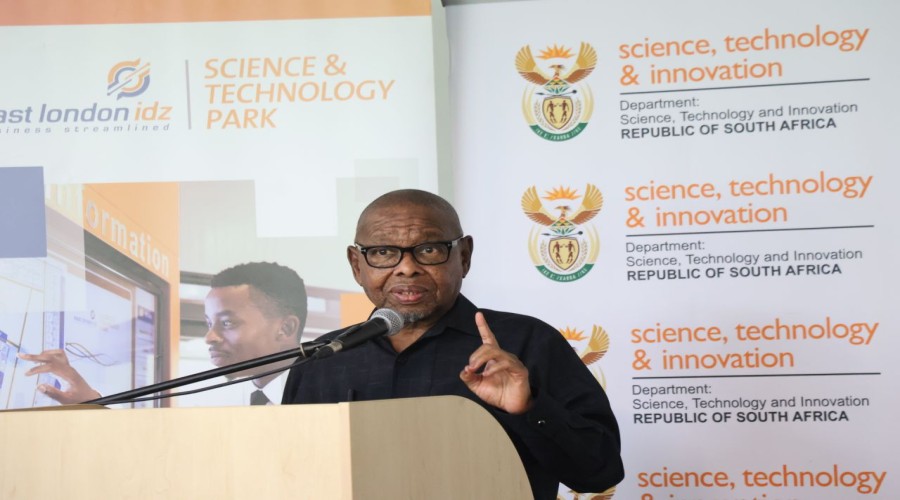
South Africa’s Minister of
Science, Technology and Innovation, Professor Blade Nzimande, has called for
stronger partnerships between government, Special Economic Zones (SEZs) and
industry to advance innovation-led industrialisation and strengthen local economic
development.
Speaking during a strategic
engagement and site visit to the East London Industrial Development Zone
(ELIDZ) Science and Technology Park, Nzimande emphasised the need to connect
innovation with production and industry to support economic growth.
He described the ELIDZ as a
strategic resource for local economic development, saying its Science and
Technology Park could bring together infrastructure, investment, skills and
technology to support supplier development, commercialisation and innovative
solutions for the market.
The minister called for the
ELIDZ to be strengthened as a platform for investment, innovation, supplier
development and skills development, enabling ideas to move into factories,
prototypes into products, and local solutions into markets.
“Let us therefore strengthen
the East London Industrial Development Zone as a platform for investment,
innovation, supplier development, and skills. Let us use its Science and
Technology Park to move ideas into factories, prototypes into products, and local
solutions into markets,” he said.
Nzimande said the
government’s approach was informed by the recognition that South Africa could
not achieve meaningful industrialisation without a robust, diversified and
resilient innovation system. He added that innovation must address production
needs and the everyday development challenges facing communities.
He highlighted the role of
SEZs in broadening the country’s industrial base, supporting regional
development, attracting investment, promoting exports and creating employment.
He said the zones must also accelerate technology adoption, localisation and the
conversion of research into economic value.
According to the minister,
the success of SEZs should be measured not only by infrastructure and
investment, but also by higher productivity, supplier upgrading, patents,
prototypes, new goods and services, skills development and improved
competitiveness.
Nzimande also called for
stronger coordination among national and provincial government, Buffalo City
Metropolitan Municipality, educational institutions, science councils,
industry, investors and communities to build an innovation ecosystem in the
Eastern Cape.
He proposed consolidating
the existing regional innovation forum into a dynamic science, technology and
innovation forum for Buffalo City. The proposed forum would coordinate
institutions, identify problems requiring innovative solutions, match them with
expertise and support science and technology parks linked to Eastern Cape SEZs.
The minister outlined
support provided by the Department of Science, Technology and Innovation
through its entities, including the Council for Scientific and Industrial
Research (CSIR) and the Technology Innovation Agency (TIA).
This support included
funding for the feasibility study that led to the establishment of the ELIDZ
Science and Technology Park, launched in 2014, as well as R2.4 million provided
between 2018 and 2023 to the East London Regional Innovation Networking Platform.
The platform reached 120
beneficiaries, including 17 technology-focused small, medium and micro
enterprises, and helped catalyse the TIA-funded Agro-processing Innovation
Cluster, according to the minister’s address.
Nzimande also highlighted a
pilot bio-entrepreneurship programme intended to help emerging enterprises
convert locally available hemp and cannabis biomass into higher-value
biomaterials and biochemicals.
He said East London’s
established automotive manufacturing base offered further opportunities to
deepen local technological capabilities, citing the presence of Mercedes-Benz
South Africa, the ELIDZ Automotive Supplier Park, component manufacturers and the
Port of East London.
He called for support for
local suppliers adopting advanced manufacturing technologies, automation,
robotics, artificial intelligence and digital production systems, alongside
stronger local research and engineering capabilities.
The minister said
collaboration between the automotive industry, the ELIDZ Science and Technology
Park, universities, technical and vocational education and training colleges,
science councils and the TIA could help local innovators and emerging enterprises
participate in evolving automotive value chains.
He added that innovation-led
industrialisation should create opportunities for small enterprises, township
and rural innovators, women-owned businesses and young people, with benefits
extending beyond the zone into Buffalo City, Mdantsane, surrounding towns and
the wider provincial economy.