African Union and Google sign MoU to advance AI adoption across government, education and climate initiatives
Date: 2026-02-19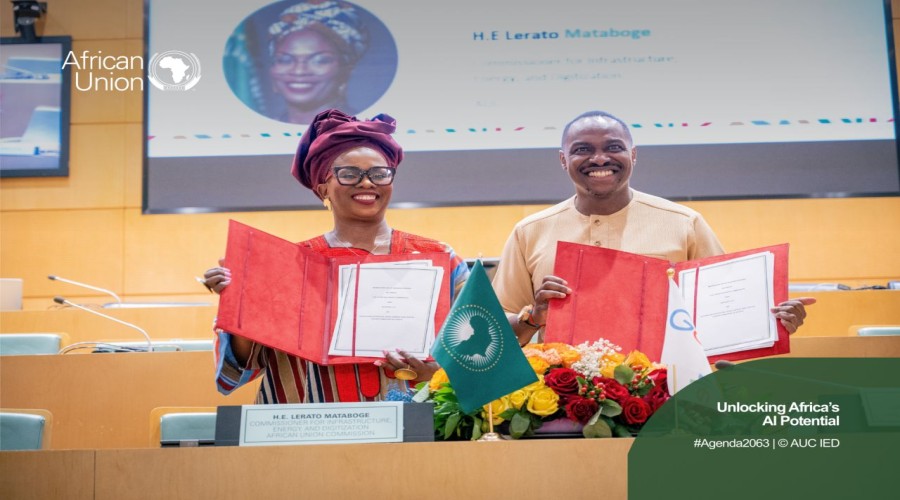
By: Nana Appiah Acquaye
The African Union Commission
(AUC) has formalised a strategic partnership with Google aimed at accelerating
the responsible adoption of artificial intelligence across Africa’s public
sector, education systems and climate resilience initiatives.
The Memorandum of
Understanding (MoU), signed at the African Union Headquarters, brings together
the AUC and Google under a framework titled “AI for Government: Strengthening
Digital Public Infrastructure, Education, and Climate Resilience.”

The agreement was signed by
H.E. Lerato D. Mataboge, African Union Commissioner for Infrastructure and
Energy, and is aligned with the African Union’s Continental AI Strategy and the
Digital Transformation Strategy (2020–2030).
According to the Commission,
the partnership prioritises capacity building, digital inclusion and
innovation. A central pillar of the initiative is an AI skilling programme
designed to equip African public officials with advanced digital competencies
to enhance governance, policy design and public service delivery.
The collaboration also
extends to the education sector, where Google will provide access to its Gemini
AI tools to support educators and strengthen digital literacy efforts across
African Union Member States. Officials say the move is intended to foster AI
readiness while promoting ethical and context-sensitive deployment of emerging
technologies.
Beyond adoption, the MoU
underscores Africa’s ambition to play a more active role in shaping AI
development. The Commission noted that the partnership seeks to support the
continent’s transition from technology consumption toward the creation of
locally relevant AI-driven solutions. Projections referenced during the signing
suggest AI could contribute as much as USD 1.5 trillion to Africa’s economy by
2030.

The ceremony featured the
participation of young African innovators, who engaged directly with
stakeholders to emphasise the importance of youth perspectives in the
implementation phase. The Commission described their involvement as symbolic of
a broader commitment to inclusive digital transformation.
Commissioner Mataboge
highlighted that the agreement represents more than a technology partnership,
framing it as an investment in infrastructure, talent development and
governance frameworks necessary for sustainable AI integration.
Industry observers note that
collaborations between global technology firms and continental institutions are
increasingly shaping Africa’s digital policy landscape, particularly as
governments seek to balance innovation, economic opportunity and regulatory
oversight in the rapidly evolving AI ecosystem.