Slamm Foundation, ISC2 expand Africa’s cyber talent pipeline as 22 young women complete intensive bootcamp
Date: 2026-03-03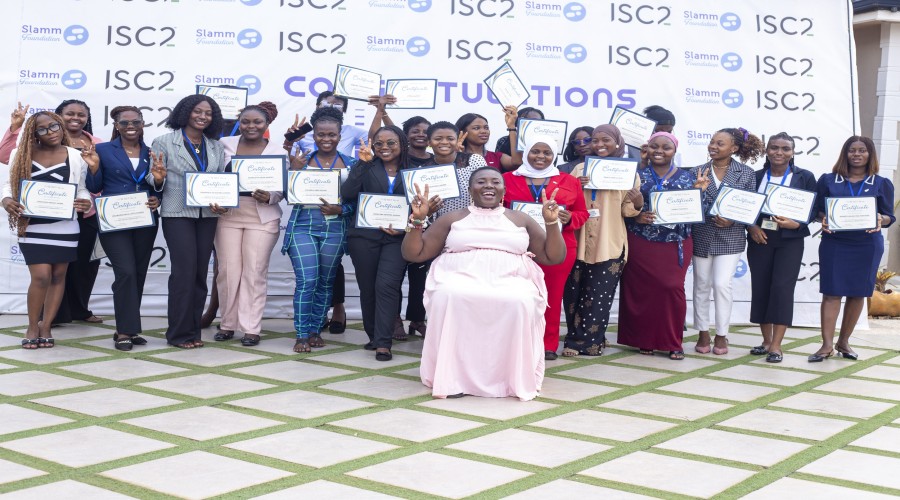
Slamm Foundation, the corporate social responsibility arm of indigenous technology services provider, Slamm Technologies, in partnership with ISC2, has graduated the fourth cohort of its flagship Young Women in Tech (YWIT) programme, marking another milestone in efforts to expand female participation in Africa’s fast-growing cybersecurity sector.
Twenty-two (22) young women completed the intensive two-week
residential boot camp held at Fab Hub Ashanti in Kumasi, emerging with
industry-relevant technical skills, structured mentorship experience and clear
pathways toward internationally recognised cybersecurity certifications.

Francisca Boateng, Chief Executive Officer of Slamm Foundation, seated, with participants in cohort 4 of Young Women in Tech programme
The programme was designed as a fully immersive experience.
Participants began each day at 5:00 a.m. with physical training and team
conditioning exercises, followed by daily orientation sessions and up to nine
hours of cybersecurity instruction. The curriculum covered core security
principles, risk management, network security fundamentals and professional
ethics, alongside public speaking and career development modules. The training
ran continuously for 14 days, including weekends.
The initiative responds to a widening talent and gender gap across
Africa’s digital economy. Women account for just 13.5 percent of the
cybersecurity workforce on the continent; the lowest regional share globally,
despite near gender parity in many STEM graduation cohorts. At the same time,
Africa faces a significant shortfall in trained cybersecurity professionals,
with fewer than 300,000 practitioners serving a population of 1.4 billion
people. Globally, an estimated 2.8 million cybersecurity roles remain unfilled.

Francisca Boateng, Chief Executive Officer of Slamm Foundation, left,
receiving an album of appreciation from participants in cohort 4 of Young Women
in Tech programme
Francisca Boateng, Chief Executive Officer of Slamm Foundation,
described the programme as a deliberate intervention aimed at shifting
long-term structural imbalances in the technology sector. “This is not
simply a graduation ceremony; it is a statement of intent. Each cohort
represents a strategic investment in Africa’s digital resilience. When we speak
about cybersecurity gaps, we are speaking about national security, economic
stability and the protection of our digital future. Women must be central to
that conversation,” she said.
She added that the discipline-centred design of the boot camp is
intentional. “We do not separate technical competence from character
development. The early mornings, the long training hours, the debates,they are
structured to build confidence, resilience and leadership capacity. Our goal is
not just to prepare participants for certification exams, but to prepare them
for boardrooms, policy discussions and entrepreneurial ventures,” she added.
Mrs. Boateng emphasised that the Foundation remains committed to
scaling the initiative, stating: “We are building a pipeline. Four cohorts in,
the evidence is clear: when you give young women access, structure and high
expectations, they exceed them. The future of Africa’s cybersecurity ecosystem
will be shaped by programmes like this.”
As ISC2 reaffirmed the organisation’s
commitment to expanding access to globally recognised credentials, including
the Certified in Cybersecurity (CC) certification, Slamm Foundation is
supporting in discharging this mandate.
The closing ceremony featured a formal certificate presentation and
a structured debate on emerging cybersecurity threats, data protection
frameworks and ethical responsibilities in digital defence. The debate served
as a practical assessment of participants’ analytical reasoning, policy
awareness and communication skills.

Francisca Boateng, Chief Executive Officer of Slamm Foundation
The session was adjudicated by a three-member panel comprising
Benedicta Boatemaa Afriyie, Team Lead at Cedafa Limited and BB Flava Foods; Ama
Duncan, entrepreneur, author and founder of the Fabulous Woman Network; and
Bernard Yaw Ashiadey, journalist with the Business & Financial Times.
One of the
participant of the fourth cohort, speaking on behalf of her colleagues,
reflected on the intensity of the experience. “I entered this programme uncertain
about my place in cybersecurity. Two weeks later, I leave with clarity and
conviction. The structure was demanding, but it revealed strengths many of us
did not know we possessed. We are not stepping into this industry quietly, we
are stepping in prepared,” she said.
She added that the residential format fostered both technical
growth and peer support. “The environment pushed us, but it also united us. We
leave not only as graduates, but as a network.”