South Africa accelerates industrial decarbonisation agenda at LeadIT Summit in Johannesburg
Date: 2026-05-30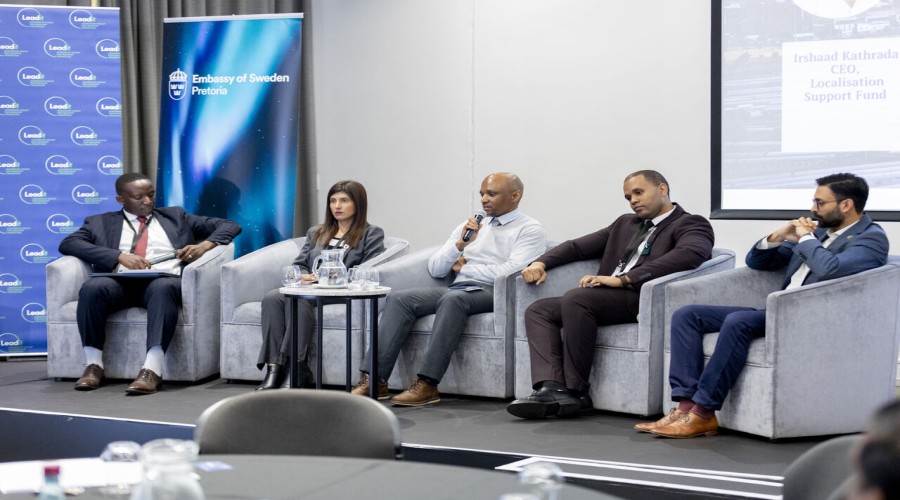
By: Nana Appiah Acquaye
South Africa’s efforts to
accelerate industrial decarbonisation were highlighted at the Leadership Group
for Industry Transition (LeadIT) Summit held in Johannesburg, where
stakeholders from government, industry, finance, and international
organisations convened to discuss pathways toward low-carbon industrial
development.
The summit focused on
advancing green steel production and strengthening carbon market mechanisms as
part of broader efforts to support sustainable industrial transformation.
The United Nations Industrial Development Organization (UNIDO) was represented by Mchenge Nyoka, who participated in a panel discussion on opportunities to accelerate industrial decarbonisation. The panel also featured representatives from the Localisation Support Fund, the Industrial Development Corporation, and the World Bank, and was moderated by the Africa Futures Policy Hub.
 During the discussion, Nyoka
highlighted UNIDO’s ongoing support for South Africa’s steel sector transition,
particularly through a proposed initiative titled “Accelerating Steel
Decarbonisation in South Africa.” The project, developed in collaboration with
key stakeholders including the Industrial Development Corporation, was
submitted to the Mitigation Action Facility in April for funding consideration.
During the discussion, Nyoka
highlighted UNIDO’s ongoing support for South Africa’s steel sector transition,
particularly through a proposed initiative titled “Accelerating Steel
Decarbonisation in South Africa.” The project, developed in collaboration with
key stakeholders including the Industrial Development Corporation, was
submitted to the Mitigation Action Facility in April for funding consideration.
The initiative aims to support the transformation of the steel industry toward near-zero-emission production through an integrated framework that combines policy development, demand stimulation for low-emission steel, capacity building, and the establishment of a dedicated financing mechanism.
UNIDO noted that effective
industrial decarbonisation will require coordinated action across government,
industry, financial institutions, civil society, and labour, with alignment on
policy direction, investment flows, technology adoption, skills development,
and just transition priorities.
According to stakeholders,
the transition to low-emission steel is critical not only for meeting South
Africa’s climate commitments but also for maintaining global market access,
improving long-term competitiveness, and positioning the sector to comply with
emerging international standards on low-carbon industrial production.