EU secures full ownership of Galileo antenna in boost to space programme sovereignty
Date: 2026-05-30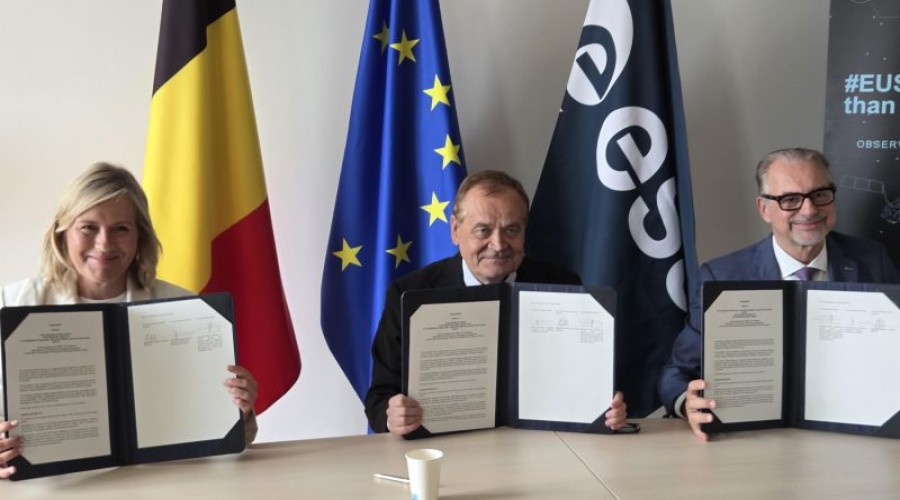
By: Nana Appiah Acquaye
The European Union has taken
full ownership of the RED-1 TTC antenna, a critical ground infrastructure asset
supporting the Galileo satellite navigation system, in a move aimed at
strengthening Europe’s space autonomy and operational security.
The transfer was formalised
through agreements signed by European Space Agency (ESA) Director-General Josef
Aschbacher, Belgium’s Minister of Public Modernisation Vanessa Matz, and
European Commission DG DEFIS Director-General Timo Pesonen.
The agreements include the
official transfer of ownership of the RED-1 TTC antenna from the European Space
Agency to the European Union, as well as a trilateral hosting arrangement
between the EU, ESA, and Belgium. Under the arrangement, the antenna will
remain at the European Space Security and Education Centre in Redu, Belgium,
ensuring its continued operational role within the EU Space Programme.

Officials described the
antenna as a key infrastructure component supporting Galileo, the European
satellite navigation system used globally for positioning, navigation, and
timing services.
Galileo is widely integrated
into consumer devices and critical infrastructure systems, with officials
noting that it serves billions of users worldwide and underpins a broad range
of economic and security applications.
The RED-1 TTC antenna is
used to support telemetry, tracking, and command functions essential for
maintaining the performance and reliability of the Galileo constellation.

According to the European
Commission, the transfer reinforces the EU’s control over strategic space
infrastructure and contributes to ensuring uninterrupted service, sovereignty,
and resilience of its satellite navigation capabilities.
The agreement was described
as a demonstration of cooperation between the European Union, the European
Space Agency, and Belgium, aimed at strengthening Europe’s leadership in space
infrastructure and technological independence.