By: Nana
Appiah Acquaye
The Gabonese Agency for
Space Studies and Observations (AGEOS) has highlighted its growing role in
scientific research and innovation aimed at improving the monitoring and
preservation of the Congo Basin forests.
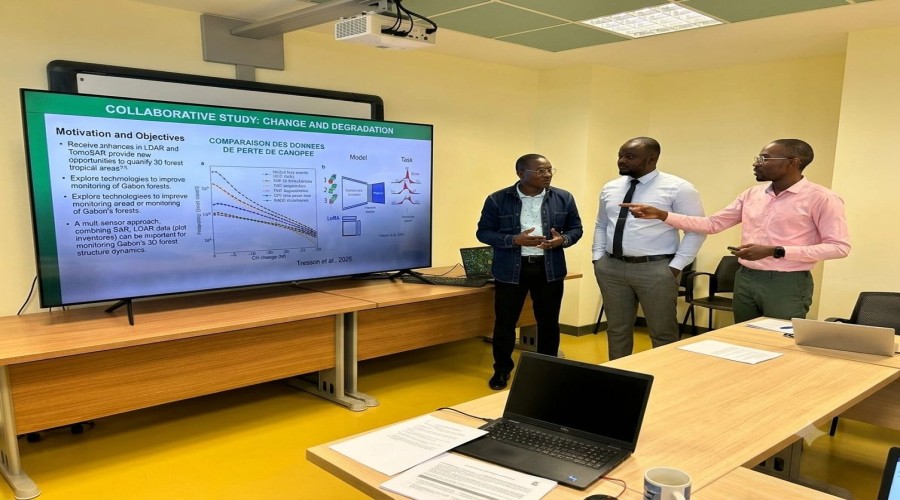
The agency’s Research and
Innovation Week, marked the official launch of activities under AGEOS’ Research
and Innovation component and showcased research being conducted by four PhD
students working with the agency and its academic and international research
partners.
The research focuses on the
use of remote sensing, artificial intelligence, drone imagery and advanced
radar technologies to improve understanding of forest ecosystems and address
challenges linked to climate change, biodiversity loss and sustainable resource
management.
Vanessa Ovono Angoue, who is
affiliated with Marien University of Brazzaville, the Laboratory of Tropical
Ecology and Forestry, LAGRAC at the University of Omar Bongo and AGEOS, is
researching the mapping of forest degradation in northern and north-eastern
Gabon.
Her work seeks to identify
and quantify early indicators of environmental degradation, with the objective
of supporting efforts to prevent deforestation, assess ecosystem health and
improve forest carbon estimates.
Carmel Mounziegou,
affiliated with the University of Montpellier, UMR AMAP, IRD/CIRAD, AGEOS and
IRET, is conducting regional research into forest typology through the
integration of optical, radar, LiDAR, drone, field and artificial intelligence
data.
The approach is intended to
improve the level of detail and accuracy of forest reference maps, providing
data that can support biodiversity monitoring and more sustainable management
of forest resources.
Yann Ibinga-Bouassa, from
the University of Science and Technology of Masuku and working with AGEOS and
the Laboratory of Climate and Environmental Sciences (LSCE) at the French
Alternative Energies and Atomic Energy Commission (CEA), is focusing on estimating
and mapping changes in Gabon’s forest carbon stocks.
His research combines
artificial intelligence with satellite and drone imagery to develop faster,
more accurate and cost-effective approaches to carbon monitoring. The work
could strengthen Gabon’s capacity to generate scientific data for international
climate finance mechanisms, including carbon markets.
Fred Missono, working with
the German Aerospace Center (DLR) and AGEOS, is developing three-dimensional
models of forest vertical structure using advanced radar technologies,
including P-band, TomoSAR and InSAR.
The research is designed to
improve the measurement of tree height, canopy structure and forest biomass,
with potential applications in REDD+ monitoring and land-use planning.
AGEOS said the research
demonstrates the importance of collaboration between national institutions,
universities and international research centres in developing advanced
capabilities for Earth observation and environmental monitoring.