By: Nana
Appiah Acquaye
A lunar sample collected
from the far side of the Moon by China’s Chang’e-6 mission has been donated to
the United Nations Office for Outer Space Affairs (UNOOSA) and is now housed at
the United Nations in Vienna.
The sample, collected in
2024 from the South Pole–Aitken Basin, was donated by the China National Space
Administration (CNSA) to UNOOSA. Chang’e-6 was the first mission in history to
return samples from the far side of the Moon, providing scientists with
material from a region of the lunar surface that has never been visited by
humans.
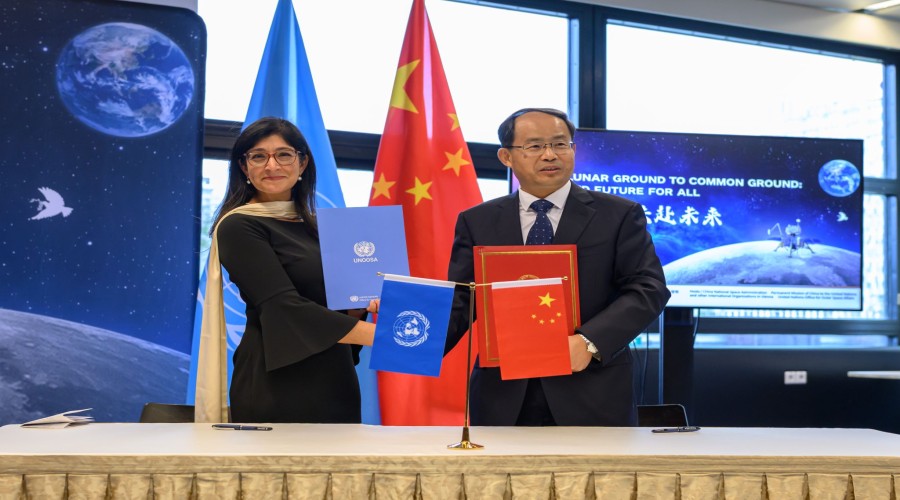
The handover ceremony in
Vienna brought together United Nations Office at Vienna and UNODC
Director-General Monica Juma, CNSA Director Shan Zhongde, Ambassador Li Song of
China and UNOOSA Director Aarti Holla-Maini. Representatives of countries that
cooperated on the Chang’e-6 mission, including Italy and Pakistan, also
attended the ceremony.
Ambassador Debora Lepre of
Italy and Ambassador Kamran Akhtar Malik of Pakistan represented their
respective countries at the event, highlighting the international cooperation
that contributed to the Chang’e-6 mission.
Holla-Maini said the lunar
sample represents more than a piece of material from the Moon’s far side,
describing it as a tangible indication that a new era of lunar activity is
taking shape.
The donation comes as an
increasing number of countries and other actors look towards the Moon for
scientific exploration and other peaceful activities. UNOOSA said international
cooperation will be essential as lunar activities expand, with the UN Committee
on the Peaceful Uses of Outer Space (COPUOS) providing a platform for
discussions on ensuring that activities in outer space, including on and around
the Moon, are conducted for peaceful purposes.
The discussion will continue
in Vienna in December during the 2026 United Nations Conference on Lunar
Activities, organised by UNOOSA at the Vienna International Centre from
December 9 to 11.
The conference will bring
together policymakers, experts, industry representatives, academics and civil
society to advance international dialogue and cooperation on lunar activities.
UNOOSA said the donation by
the Government of China brings a significant piece of lunar exploration to the
United Nations and provides a tangible connection to one of the least explored
regions of the Moon.