By: Kanto
Kai Okanta
Malawi’s Deputy Minister of
Education, Science and Technology, Francis Folley, has expressed satisfaction
with the progress of major infrastructure projects at the Malawi University of
Science and Technology (MUST), describing the developments as evidence of
Government’s commitment to expanding infrastructure in public universities.
Folley made the remarks
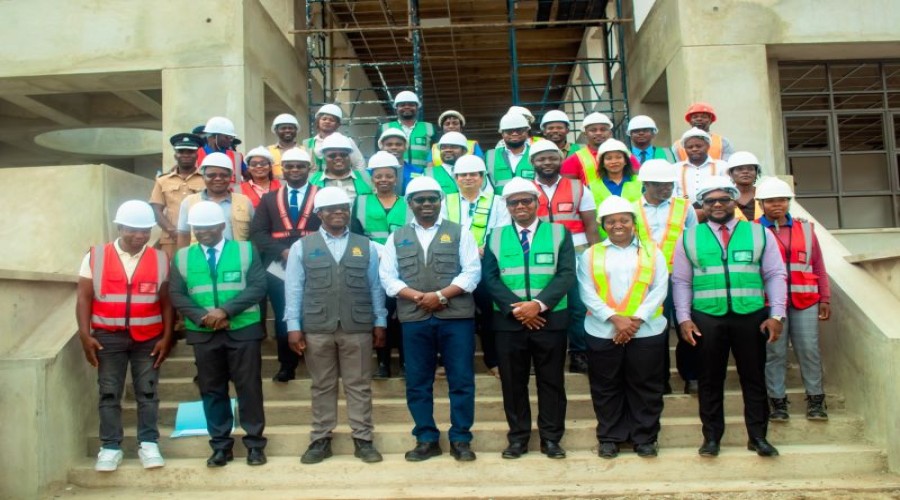
during a visit to MUST, where he toured two flagship construction projects,
including a lecture theatre complex funded by the World Bank under the Skills
for a Vibrant Economy (SAVE) Project and a purpose-built laboratory complex funded
by the Malawi Government through the Public Sector Investment Programme (PSIP).
The SAVE Project lecture
theatre complex is currently 85 percent complete and will include three lecture
theatres with a combined seating capacity of about 600, as well as offices and
spaces for small-group discussions.
Folley reminded the
contractor that the lecture theatre project must be completed by October 1,
2026, in line with the agreement between the World Bank and the Malawi
Government. He said it was surprising that the works had been delayed despite
funding being available for their completion.
The second major project,
the laboratory complex, is currently 55 percent complete. Construction works
had stopped due to funding and other contractual issues but are expected to
resume soon.
Professor Mwapatsa Mipando,
Vice Chancellor of MUST, said the new laboratory complex would provide students
with facilities to conduct practical work on campus, reducing their reliance on
industrial placements for practical training.
A music studio is also being
constructed at the Bingu School of Culture and Heritage to support the
preservation of Malawian music while providing students with hands-on training.
Government has so far
disbursed about K9 billion towards the projects.
Folley said the
infrastructure developments demonstrate the Government’s commitment to
providing public universities with fit-for-purpose learning spaces, offices and
other facilities.
He also emphasised the role
of higher education institutions such as MUST in national development through
human capital development, innovation and the creation of skills required in a
changing global environment.
According to Folley, the
developments at MUST align with the Malawi 2063 aspirations, which seek to
transform Malawi into an inclusively wealthy, self-reliant, industrialised and
upper-middle-income country.
“Such transformation
requires vibrant higher education institutions that develop the country’s human
capital and promote the right mindset for development,” he said.
MUST Vice Chancellor
Associate Professor Mwapatsa Mipando welcomed the ministerial visit and
reiterated the university’s vision of becoming a world-class centre for
science, technology and entrepreneurship.