By: Nana
Appiah Acquaye
Artificial intelligence can
help transform medical practice by supporting diagnosis, integrating complex
patient data and improving access to healthcare, but it must remain a tool for
clinical decision-making rather than a substitute for physicians, according to
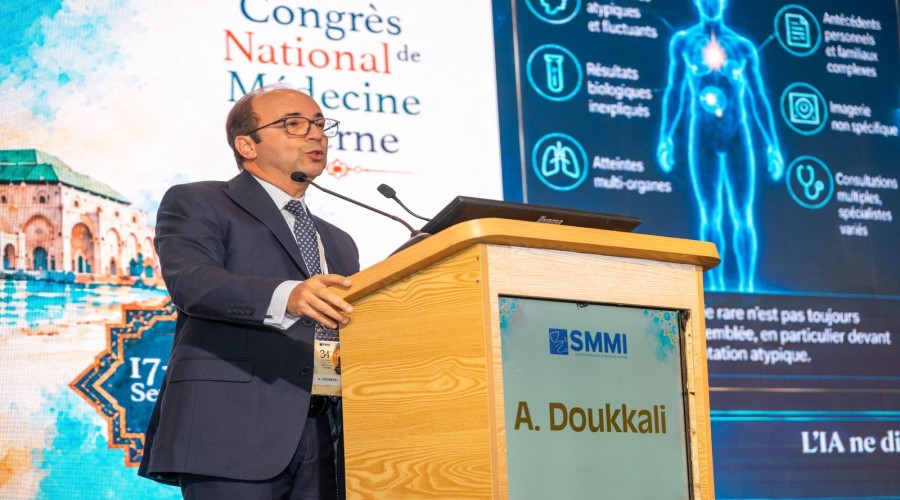
Professor Anass Doukkali of the Faculty of Medicine and Pharmacy of Rabat at
Mohammed V University.
Doukkali made the remarks
during the 34th National Congress of the Moroccan Society of Internal Medicine
(SMMI) in Casablanca, where he spoke at a plenary conference dedicated to “AI
and Health: Perspectives and Limits.”
His presentation examined
artificial intelligence not only from the perspective of technological
performance but also through the question of how AI could transform the daily
practice of doctors.
For internists, who
routinely manage complex cases, multimorbidity and diagnostic uncertainty,
Doukkali said AI could serve as a tool for clinical augmentation. This could
include better integration of fragmented patient data, support for differential
diagnosis, anticipation of certain developments and reducing the amount of time
physicians spend on tasks with limited clinical value.
He also examined the
potential of AI beyond individual medical practice and hospitals, including
earlier screening, extending specialist expertise to areas where it is limited
and improving access to care.
Among the areas identified
were medical imaging, anatomical pathology, cancer screening and maternal
health.
However, Doukkali stressed
that technological performance does not automatically translate into trust. He
identified explainability, AI hallucinations, algorithmic bias, the
representativeness of populations in datasets, data protection and medical
liability as issues that must remain central to discussions around AI in
healthcare.
He argued that AI should
inform medical decisions while clinical judgment and responsibility remain with
physicians.
Doukkali also placed the
discussion within the Moroccan healthcare context, referencing the work of the
CIES, e-Health Innovation Center, through its White Paper on AI in Health, as
well as the Mahir – Moroccan AI for Health Implementation and Readiness programme.
According to Doukkali, the
approach should begin with clinical needs and the requirements of the
healthcare system rather than adopting AI simply for the sake of using the
technology.
He said this requires the
development of foundational capabilities, including high-quality data,
interoperability, governance, relevant skills, scientific evaluation and the
capacity to scale successful pilot projects.