By: Nana
Appiah Acquaye
Ghana’s Minister for
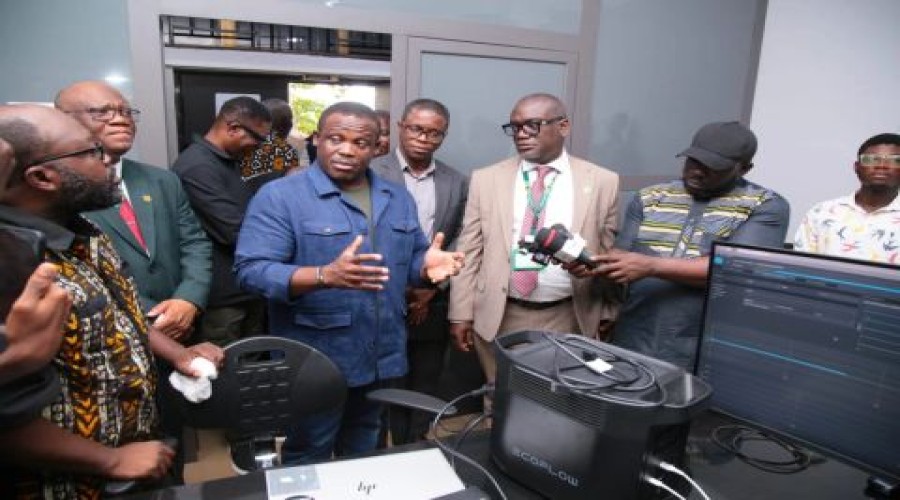
Communication, Digital Technology and Innovations has visited the photonics and
optics laboratory at the Kwame Nkrumah University of Science and Technology
(KNUST) to examine local innovations in encryption, environmental and health
monitoring, and national security.
The visit took place during
the Minister’s Ashanti Regional tour to inspect digital and telephony projects.
He toured the laboratory alongside Prof. Kwabena Biritwum Nyarko, Provost of
KNUST’s College of Engineering.
Guided by Dr. Akyana
Britwum, the laboratory’s Principal Investigator and Scientific Lead, the
delegation explored local innovations designed to future-proof science
education and national security.
These included a low-cost
Quantum Key Distribution setup for encryption training and locally built,
significantly cheaper spectrometers intended to make environmental and health
monitoring more accessible.
The visit also highlighted
international partnerships supporting the laboratory’s development,
particularly its collaboration with the University of St Andrews in Scotland.
Through their joint
UK-funded BOSOMTWE project, the University of St Andrews has supported capacity
building in microscopy and spectroscopy, trained GPOL scientists and helped
place advanced scientific tools in Ghanaian hands.
The delegation also viewed
the laboratory’s through-barrier Raman spectrometer, an instrument built at the
University of St Andrews by Dr. George Dwapanyin and Dr. Graham Bruce. The
technology identifies medicines and other substances through sealed packaging
without opening it and is now permanently installed at KNUST to support efforts
to combat counterfeit drugs.
Discussions also focused on
translating laboratory research into industrial applications and creating jobs
for young graduates.
Prof. Nyarko and the
Minister emphasised the need to scale locally developed solutions across the
sub-region through strategic institutional partnerships, underscoring their
shared commitment to building home-grown technological ecosystems.