By: Tewodros Balcha Mulisa
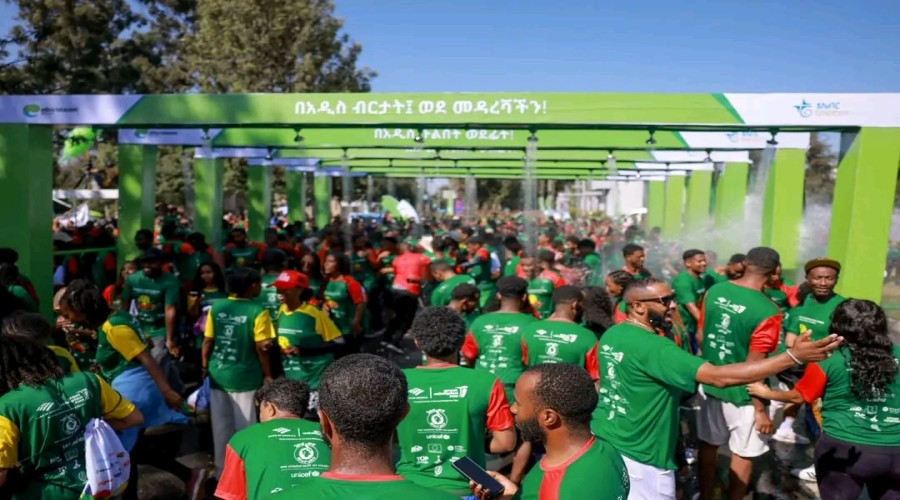
More than 60,000 runners took to the
streets of Addis Ababa on Sunday for the 26th Great Ethiopian Run, in an
edition that brought together Ethiopian sporting heritage, international
commercial investment and the growing role of digital services in mass
participation.
Under the theme My Run,
My Color, the event attracted approximately 200 international
participants from 25 countries, according to the Ethiopian News Agency. Founded
in 2001 by Haile Gebrselassie, the race has evolved into one of Africa's most
recognisable mass-participation sporting events.
This year's edition also marked the
first under a new multi-year presenting partnership with Bank of America, while
Ethiopian telecommunications pioneer Ethio telecom and its digital financial
services platform, telebirr, formed part of the event's supporting ecosystem.
Although the two institutions have
distinct roles and are not joint commercial partners, their presence around the
same sporting platform offers an interesting perspective on the intersection of
international finance, telecommunications and African sport.
BANK OF AMERICA TAKES ITS
PARTNERSHIP PORTFOLIO INTO AFRICA
Announced in November 2025, Bank of
America's multi-year agreement with the Great Ethiopian Run extends its
established involvement in international endurance sport to one of Africa's
most distinctive running communities.
The agreement covers the Great
Ethiopian Run International 10km and its associated Children's Races, with the
Women First 5km scheduled to join the partnership in 2027.
The move places the Addis Ababa
event within a broader endurance-sport portfolio that includes the Boston
Marathon and the Bank of America Chicago Marathon.
Beyond the presenting-partner
designation, the agreement identifies wider ambitions: expanding access to
running, encouraging youth participation, supporting women in sport and
strengthening the contribution of the event to local economic activity through
sport, tourism and enterprise.
One visible feature of the 2026
edition was the introduction of a dedicated Yellow Start for high-school
graduates, with their participation places sponsored by Bank of America.
The partnership also forms part of
the organisers' longer-term ambition to develop the Great Ethiopian Run into
the world's largest 10km road race by 2030.
For Bank of America, the partnership
offers a connection with Ethiopia's exceptional distance-running culture. For
the organisers, it provides an international commercial relationship with the
potential to support the event's next phase of development.
ETHIO TELECOM: CONNECTIVITY
MEETS MASS PARTICIPATION
There is a parallel story in the
involvement of Ethio telecom, whose contribution connects the event to
Ethiopia's evolving digital economy.
Telebirr, the company's digital
financial services platform, featured in the local registration process
promoted to Ethiopian participants. Its relevance goes beyond conventional
event sponsorship: it illustrates how digital payment services can become part
of the infrastructure supporting large public and sporting activities.
A mass-participation event of this
scale involves more than the physical race. Registration, payments, participant
communication and event coordination are all part of the wider operational
ecosystem.
The integration of digital financial
services into that journey provides a practical setting in which their everyday
economic relevance can be demonstrated.
For Ethio telecom, this also
reflects a wider institutional transformation.
Ethiopia's telecommunications
history dates to 1894, when Emperor Menelik II initiated the construction of a
telephone line connecting Harar and Addis Ababa. Ethio telecom, in its present
institutional form, was established on 29 November 2010, inheriting a much
longer national telecommunications legacy.
Its evolution from a traditional
telecommunications operator into a provider of connectivity, enterprise
technology and digital financial services is reflected in the development of
telebirr, launched in 2021.
The Great Ethiopian Run offers a
particularly visible public setting for that evolution: digital services
meeting everyday participation on a scale rarely demonstrated through
conventional corporate communications.
TWO DIFFERENT HISTORIES, ONE
PUBLIC PLATFORM
The institutional histories of Bank
of America and Ethio telecom provide another interesting dimension to their
presence at this year's event.
Bank of America's roots trace back
to the Bank of Italy, established in San Francisco in 1904 by Amadeo Peter
Giannini to extend banking services to communities underserved by established
financial institutions. The institution adopted the Bank of America name in
1930.
Ethio telecom's history reaches back
to the introduction of telephone services in Ethiopia in the late nineteenth
century.
Their journeys are distinct, and
their participation in the Great Ethiopian Run does not establish a business
relationship between them. Yet both illustrate how institutions built around
essential services have adapted to changing expectations and expanding public
needs.
One represents a major international
financial institution extending its engagement with endurance sport into
Africa. The other represents an Ethiopian institution connecting a growing
digital economy with everyday life.
The Great Ethiopian Run provides a
common public platform on which these different institutional stories
intersect.
FROM ETHIOPIAN ATHLETICS TO
INTERNATIONAL SPORTING RECOGNITION
The international dimension was
further strengthened by the presence of Kenya's Beatrice Chebet as Guest of
Honour.
The double Olympic champion won gold
in both the 5,000m and 10,000m at the Paris 2024 Games before securing both
titles again at the 2025 World Athletics Championships in Tokyo.
Making her first visit to Ethiopia,
Chebet highlighted the importance of the race in giving young athletes
opportunities to compete alongside established Ethiopian runners and
encouraging wider participation in physical activity.
Her appearance also reinforced the
event's ability to bring together leading figures from across East African
athletics, a region whose distance-running traditions have helped shape the
international sport.
The Great Ethiopian Run's growing
international standing received further recognition in 2026 through its
designation as a World Athletics Heritage event, as reported by the Ethiopian
News Agency.
That recognition adds another
dimension to an event whose significance extends beyond its annual
participation figures.
THE NEXT 10KM: BUILDING AN
INTERNATIONAL SPORTING INSTITUTION
The ambition to become the world's
largest 10km road race by 2030 presents the organisers with an opportunity that
extends well beyond attracting larger fields.
It requires sustained investment in
event management, participant services, international marketing, youth
development, commercial partnerships and the broader visitor experience.
Bank of America's multi-year
commitment brings an established international financial brand into that
development journey. The participation of Ethiopian institutions, including
Ethio telecom, demonstrates the importance of domestic partnerships and digital
capabilities in supporting the event's continued growth.
For Addis Ababa, the opportunity
also reaches into tourism, hospitality and local enterprise. The presence of
international runners and accompanying visitors creates a platform for
showcasing the city's cultural identity and Ethiopia's wider sporting appeal,
although the economic contribution of this edition has yet to be quantified.
Twenty-six editions after Haile
Gebrselassie established the race, the Great Ethiopian Run is increasingly more
than an annual celebration of athletics. It is a platform through which
Ethiopia can connect its sporting heritage with international business, digital
innovation and destination visibility.
On Sunday, the streets of Addis
Ababa provided the spectacle of 60,000 runners. Behind it was a wider story: an
Ethiopian sporting institution entering a new phase of international
partnership, a major American financial brand deepening its engagement with
African sport, and a homegrown telecommunications institution demonstrating the
relevance of digital services to everyday participation.
The distance was 10 kilometres. The
international opportunity is considerably greater.