By: Nana Appiah
Acquaye
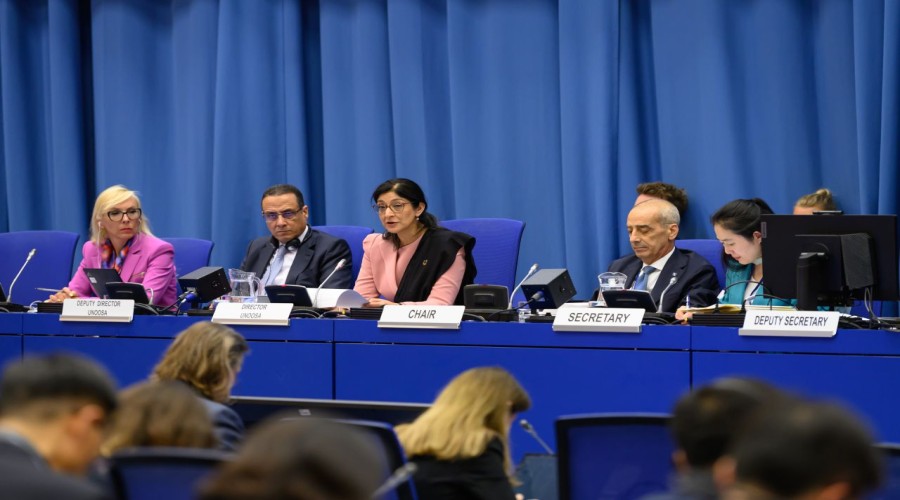
The United Nations Committee
on the Peaceful Uses of Outer Space (COPUOS) has opened its 69th session in
Vienna, welcoming six new member states and advancing discussions on key issues
shaping the future of global space governance.
The session began with the
admission of Côte d'Ivoire, The Gambia, Honduras, the Maldives, Malta and
Zimbabwe, increasing the committee’s membership to 110 states. Applications for
membership from The Bahamas, Kyrgyzstan, Serbia and Uganda were also presented
during the opening proceedings.
COPUOS also received
applications for observer status from several organizations, including
AstroAccess, AstroAid Foundation, the Center for Advocacy and Global Growth,
the Centre for Humanitarian Dialogue, Asociación Chilena del Espacio AG, Cosmic
Footprint Society and the Latin American Association of Air and Space Law.
Addressing delegates,
Director of the United Nations Office for Outer Space Affairs (UNOOSA), Aarti
Holla-Maini, highlighted the committee’s ongoing work in areas including space
resources, nuclear power sources in outer space, planetary defence, space situational
awareness, information-sharing and lunar coordination.
“The Committee continues to
make tangible progress on space resources, nuclear power sources, planetary
defence, space situational awareness, information-sharing, and lunar
coordination. This work directly responds to urgent current and future
operational priorities,” she said.
During the session,
Professor Teodoro Valente of Italy, President of the Italian Space Agency, was
elected Chair of COPUOS for the 2026–2027 term. He will serve alongside First
Vice-Chair Melita Zupevc of Slovenia and Second Vice-Chair and Rapporteur Akeem
Babatunde Rabiu of Nigeria.
In his opening remarks,
Valente emphasized the importance of international cooperation and responsible
exploration in an evolving global space sector.
“As Chair, and as head of a
space agency, I see great opportunities ahead to strengthen cooperation,
support innovation, and expand exploration responsibly,” he said, adding that
the committee must remain responsive to the demands of the rapidly growing space
economy.
The session also marked a
milestone for the United Nations Platform for Space-based Information for
Disaster Management and Emergency Response (UN-SPIDER), which has now been
formally recognized as an operational partner within the United Nations humanitarian
system. The recognition strengthens the use of space technologies in disaster
preparedness and emergency response efforts worldwide.
UNOOSA further announced the
launch of the Space4Resilience initiative, a new programme designed to support
Small Island Developing States in addressing the impacts of sea-level rise
through the use of space technologies and artificial intelligence-powered
digital twin solutions.
Another key development was
the unveiling of the Space Solutions Gateway, a beta platform that provides
access to more than 1,000 space-related solutions aimed at helping member
states connect societal challenges with available space-based capabilities and
technologies.
In a separate announcement,
UNOOSA and the Japan Aerospace Exploration Agency (JAXA) revealed the winners
of the ninth round of the KiboCUBE programme, which offers educational
institutions the opportunity to deploy CubeSats from the International Space Station.
Winning teams from El
Salvador’s Key Institute and Thailand’s Chulalongkorn University will have
their CubeSats deployed through the programme. The Salvadoran project, named
CAREY, will become the country’s first university-developed CubeSat.
The 69th session of COPUOS
continues in Vienna with member states expected to discuss international
cooperation, sustainable space activities, capacity building and emerging
challenges in the global space sector.