By: Nana
Appiah Acquaye
Professor Jerry John Kponyo,
Principal Investigator and Scientific Director of the Responsible AI Lab
(RAIL), has called for greater consideration of local voices, data and
regulatory frameworks as emerging technologies reshape societies, particularly
in low- and middle-income countries (LMICs).
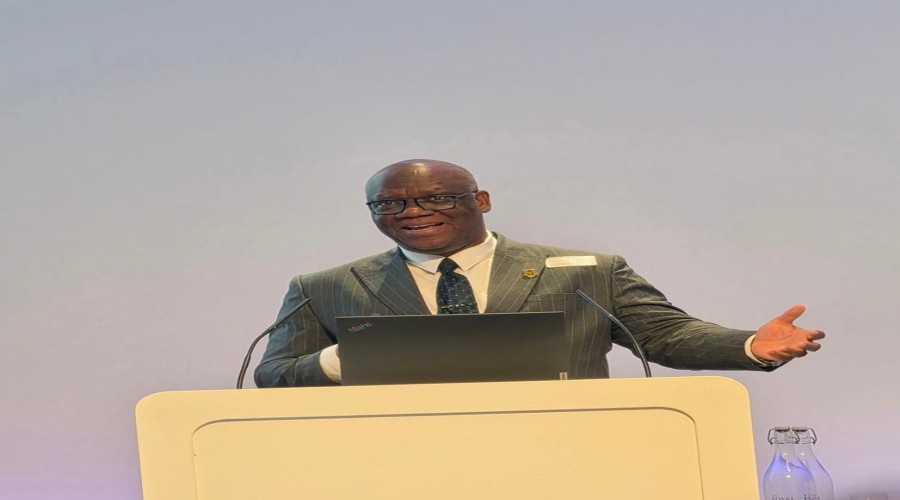
Prof. Kponyo made the case
while participating in the Resilience and Renewable Society (RRS) Summit at the
Royal Society, where he presented perspectives on emerging technologies and
their associated risks from the viewpoint of LMICs.
Organised by the Center for
Active Resilience and Security (CARS) at Imperial College London, the summit
brought together leaders from academia, NGOs, government, policy and the
private sector to examine lessons from recent crises, test future scenarios and
develop strategies for building societal resilience.
The summit addressed
resilience across natural disasters, energy system disruption and emerging
threats, with discussions focusing on whole-of-society approaches, critical
infrastructure, perspectives from LMICs, and the relationship between
resilience, security and public trust.
In his address, Prof. Kponyo
emphasised that the global technology landscape extends beyond artificial
intelligence models, noting the rapid emergence of new models and platforms and
the widespread adoption of mobile and cloud technologies.
He highlighted the growing
use of AI and machine learning across the region, including applications that
automate complex tasks, support agricultural innovation and food security, and
advance digital health solutions.
Prof. Kponyo also pointed to
the potential of quantum computing to address complex optimisation problems,
support the expansion of power grids and contribute to the development of
post-quantum cryptography.
He further noted that AI is
evolving from systems that primarily generate answers towards systems capable
of pursuing goals, raising questions about oversight and accountability as
their capabilities become more advanced.
“The question is not only
what AI can do,” Prof. Kponyo said, “but who can stop it, audit it, and govern
it.”
Against this backdrop, he
argued that the development and deployment of safe technology in low- and
middle-income countries must be grounded in local voices, local data and local
rules.
His contribution to the RRS
Summit placed the experiences and priorities of LMICs within wider global
discussions on emerging technologies, resilience and security, highlighting the
need for technology governance approaches that reflect the realities of the
communities where these systems are deployed.