By: Nana Appiah Acquaye
Physician,
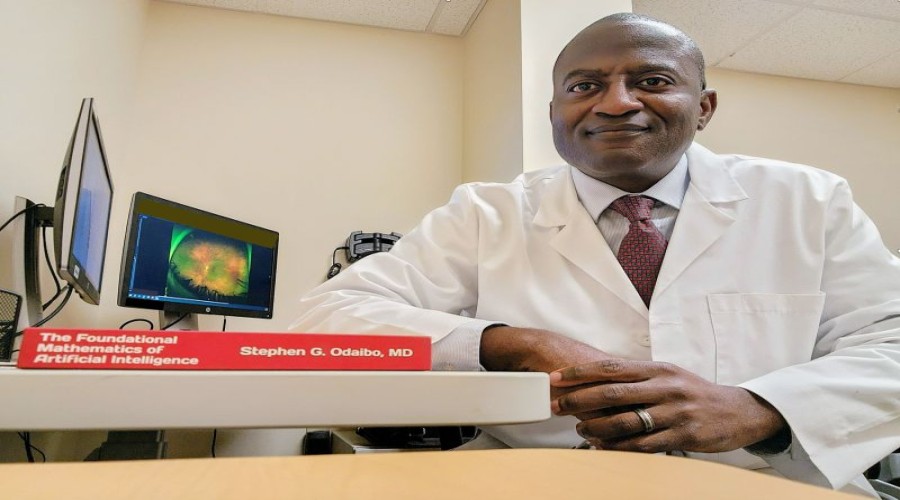
researcher, and AI engineer Dr. Stephen Odaibo has reflected on his academic
and professional journey, tracing a path that spans mathematics, computer
science, medicine, and biopharmaceutical research, underscoring the importance
of foundational scientific training in advancing emerging technologies such as
artificial intelligence in drug discovery.
Dr.
Odaibo, a retina specialist and founder of Deep EigenMatics, outlined his early
academic trajectory after arriving in the United States from Nigeria at age 17.
He completed undergraduate and master’s studies in mathematics at the
University of Alabama at Birmingham before earning a Doctor of Medicine degree
from Duke Medical School, where he also trained in GPCR biology under Nobel
Laureate Dr. Robert J. Lefkowitz and obtained a master’s degree in computer
science.
He
emphasized the role of rigorous mathematical training in shaping his approach
to problem-solving, particularly through participation in a National Science
Foundation-supported fast-track mathematics program focused on formal
proof-based reasoning.
In
his current work, Dr. Odaibo combines clinical practice in ophthalmology and
retina care with research in AI-driven drug discovery. He noted that he has
been granted or allowed more than 10 U.S. patents in AI-based drug discovery
methods within a short period, positioning his work at the intersection of
computational science and biomedical innovation.
While
acknowledging the rapid growth of investment and interest in AI for drug
discovery, he cautioned that clinical validation remains limited, pointing to
the absence of FDA-approved drugs discovered primarily through AI systems. He
argued that this gap underscores the need for rigorous scientific validation
and foundational principles rather than reliance on hype or capital intensity
alone.
Dr.
Odaibo concluded that the future of drug discovery will depend on
interdisciplinary approaches that integrate mathematics, computation, and
biology, alongside a commitment to scientific rigor and clinical proof.