By: Nana
Appiah Acquaye
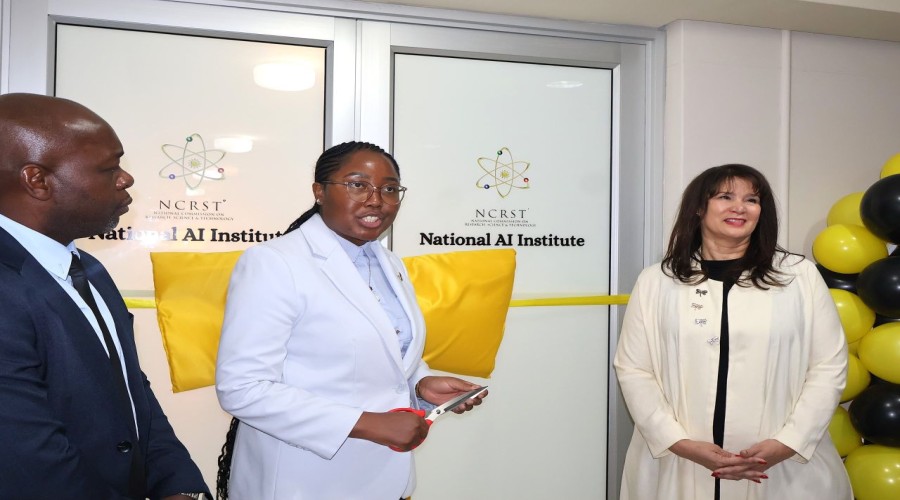
Namibia has officially
launched its National Artificial Intelligence Institute to strengthen the
country’s capacity in AI research, data, innovation and development.
The National Commission on
Research, Science and Technology (NCRST) launched the Institute, establishing a
national platform to support the development and application of artificial
intelligence in line with Namibia’s socio-economic and national development
priorities.
The Institute was
established in line with the Sixth National Development Plan (NDP6), the
National Digital Strategy, the Namibia AI Readiness Assessment Report and
Cabinet Decision No. 14th/23.08.22/001 on the recommendations of the
Presidential Fourth Industrial Revolution (4IR) Task Force. NCRST was assigned
responsibility for leading the development of Namibia’s National AI Strategy
and establishing the Institute.
Anchored at NCRST, the
Institute will operate through four interconnected centres covering Research
and Development, Datasets, Software Development and AI Innovation. The centres
will support locally relevant AI research, datasets, solutions and innovations
tailored to Namibia’s development needs.
Delivering the keynote
address, Hon. Emma Theofelus, Minister of Information, Communications and
Technology, positioned the Institute within Namibia’s broader digital
transformation agenda, highlighting its potential to strengthen digital
government, improve public service delivery and support locally developed
technology and innovation.
Speaking on behalf of Hon.
Dr Sanet Steenkamp, Minister of Education, Innovation, Youth, Sports, Arts and
Culture, Dr Lisho Mundia, Deputy Executive Director for the Department of
Higher Education, Training, Research and Innovation, emphasised the importance
of strengthening Namibia’s human capital and creating opportunities for young
Namibians to acquire the knowledge and skills needed to participate in an
increasingly technology-driven economy.
NCRST Chief Executive
Officer Prof Dr Anicia Peters highlighted the importance of connecting
Namibia’s existing research expertise, computing infrastructure and data
capacity to build national AI capabilities. She emphasised that Namibia cannot
remain merely a consumer of AI developed elsewhere, but must build the capacity
to understand AI, adapt it to local circumstances and increasingly develop its
own solutions.
Responsible and
Namibia-centred AI will be an overarching principle guiding the Institute’s
work.
The Institute is designed as
a national platform open to government, academia, industry, researchers,
students, learners, innovators and members of the public. Rather than replacing
existing institutions, it will connect and strengthen them through shared
national capabilities, infrastructure and programmes to advance the development
and application of AI for national development.