OmniBSIC
Bank has launched a school-based plastic recovery initiative in partnership
with the Council for Scientific and Industrial Research's Institute of
Industrial Research (CSIR-IIR) and Ocean Tribe Foundation, marking a
significant step towards advancing Ghana's circular economy agenda through
education, environmental stewardship, and industrial innovation.
The project,
themed ‘Recovering Plastics for Industry and Sustainable Environment’, was
officially launched on Thursday, June 4, 2026, at the Bank's Head Office in
Accra.
Five senior
high schools in the Greater Accra Region have been selected to participate in
the pilot phase: St. John's Grammar School, Odorgonno Senior High School, Accra
High School, O'Reilly Senior High School and Armed Forces Senior High School.
Fully
sponsored by OmniBSIC Bank, the initiative seeks to transform plastic waste
generated on school campuses into a valuable industrial resource. Through the
project, plastics recovered from participating schools will be channelled into
local manufacturing value chains, where they can be converted into products
such as floor tiles, roofing tiles, and composite materials.
CSIR-IIR
will provide the technical leadership for the programme, drawing on decades of
research into plastic recovery technologies and industrial applications, while
Ocean Tribe Foundation will lead environmental education and awareness
activities, leveraging its expertise in ocean conservation and plastic
pollution advocacy.
Addressing a growing environmental
challenge
The five
participating schools collectively generate an estimated 44,000 pieces of
plastic waste each day. equivalent to the full seating capacity of the Accra
Sports Stadium. Plastic materials, largely sachet water wrappers and plastic
bottles, account for approximately 60 percent of waste generated on the
campuses.
The
challenge extends far beyond school grounds. Ghana generates an estimated 0.8
million tonnes of plastic waste annually, while approximately 30 percent of
waste produced in the Greater Accra Region remains uncollected, often ending up
in drainage systems and coastal waters. The resulting pollution poses a
significant threat to marine ecosystems and livelihoods dependent on the
fisheries sector.
Turning waste into industrial
resources
Implementation will begin this month
with the installation of dedicated plastic recovery cages in all five schools,
supported by training sessions and awareness campaigns for students and
teachers on waste segregation, cleaning, storage, and recovery practices.
Over a
three-month collection period, students will recover and deposit plastic
materials into designated collection points. The recovered plastics will
subsequently be purchased by buy-back companies and processed into
semi-finished materials for supply to local manufacturers, creating a practical
link between environmental action and industrial production.
OmniBSIC
Bank's sponsorship covers the provision of recovery infrastructure, educational
materials, logistics support, and incentives for participating students.
At the
conclusion of the collection phase, recovery volumes from each school will be
assessed and recognised through a series of competitive and educational
activities.
A Plastic
Innovation Challenge, scheduled to be announced in October 2026, will encourage
students to showcase innovative products created from recovered plastics.
Winners will be recognised alongside the highest-performing schools, Green
Technology Clubs, and individual students at an awards ceremony planned for
November 2026.
The
programme will also incorporate financial literacy education, with students
receiving practical guidance on savings and personal finance through OmniBSIC
Bank's youth banking initiatives, including its Junior Savings Account.
Partners highlight shared commitment
Speaking at
the launch, George Tetteh Ocansey, Divisional Head and Executive Committee
Member of OmniBSIC Bank, said the project reflects the Bank's commitment to
sustainable finance and collaborative development.
“This partnership aligns with
Ghana's Sustainable Banking Principle 6 and supports Sustainable Development
Goals 4 and 17. It reinforces the bank's commitment to sustainable financing by
investing in education, fostering innovation in plastic waste management, and
building strategic partnerships that address pressing environmental challenges.
Together, through this shared commitment, we can build cleaner communities,
empower young minds, and create a lasting impact for future generations,” he
explained.
Dr. Richard Bayitse, Deputy Director
of CSIR-IIR, described the initiative as an important bridge between scientific
research and practical implementation.
“It is not
waste. It is a misplaced industrial resource. CSIR has spent decades
researching how to efficiently recover plastics and transform them into floor
tiles, roofing tiles and composite materials for our local industry. But our
laboratories cannot solve the collection problem alone. That is where this
project begins, with schools, with students, and with a bank that believes in
industrial ecology,” he said,
For Madam
Saviour Agyei, Programmes Manager of Ocean Tribe Foundation, education remains
central to long-term environmental change.
“Lasting change begins with
education, empowering our students to become champions of environmental
stewardship who will inspire generations to come. When a child understands the
value of a clean ocean, they become its lifelong defender,” she noted.
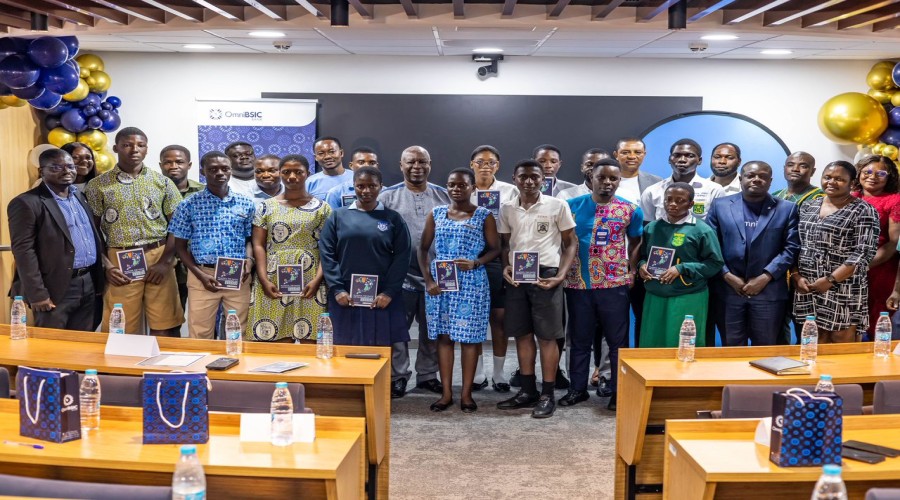
Educational resource launched
As part of
the event, OmniBSIC Bank and CSIR-IIR jointly unveiled “Plastics, the Waste and
the Management for Teens”, an educational booklet developed to provide students
with practical knowledge on plastic waste management, recycling practices, and
environmental responsibility. Copies of the publication were presented to
representatives of all five participating schools.
Supporting national and global
sustainability goals
The
initiative supports Ghana's Sustainable Banking Principles, national
environmental sustainability objectives, and the country's broader circular
economy ambitions. It also contributes directly to the achievement of the
United Nations Sustainable Development Goals, particularly SDG 4 (Quality
Education) and SDG 17 (Partnerships for the Goals).