By: Nana
Appiah Acquaye
Côte d’Ivoire and the
Republic of Congo have agreed to deepen cooperation in technical and vocational
education, with Congo seeking to draw on the Ivorian experience in establishing
Technology and Industrial Sciences Preparatory Classes.
The discussions took place
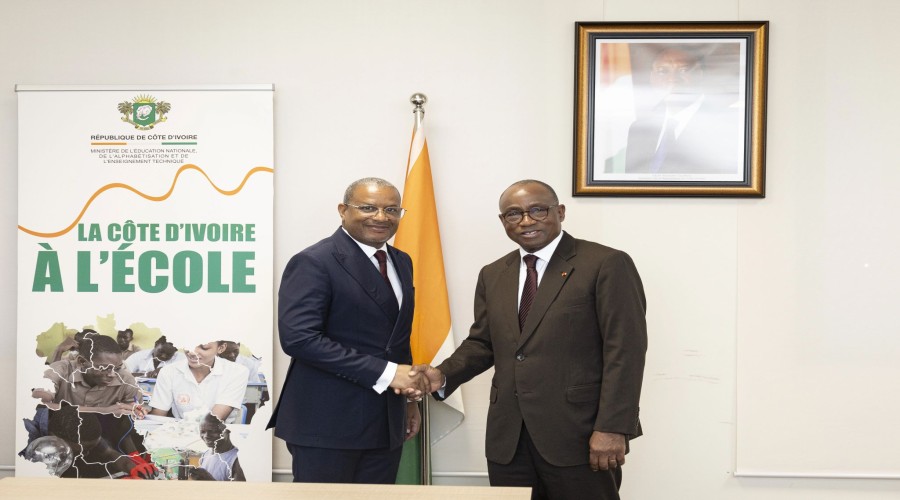
on Thursday, August 27, 2026, when Côte d’Ivoire’s Minister of National
Education, Literacy and Technical Education, N'Guessan Koffi, received a
delegation from the Republic of Congo led by Minister of Technical and
Vocational Education Gustave Fulgence René Adicole Goum.
The meeting formed part of a
mission aimed at strengthening cooperation between the two countries and
followed a cooperation agreement signed in May 2024 in the field of technical
and vocational education.
Under the agreement, Côte
d’Ivoire welcomed five Congolese learners into its Technology and Industrial
Sciences Preparatory Classes (TSI Preparatory Classes), where they completed
two years of training. The learners subsequently obtained scholarships enabling
them to continue their studies at engineering schools in France.
Speaking during the meeting,
Minister Adicole Goum expressed appreciation to his Ivorian counterpart for the
quality of training provided to the Congolese learners. He also indicated that
the Republic of Congo intends to draw inspiration from the Ivorian model in
establishing its own Preparatory Classes.
“We will draw inspiration
from the Ivorian model for the establishment of our Preparatory Classes,”
Adicole Goum said.
The two sides also discussed
additional areas of cooperation, including the training of trainers, revision
of training programmes and stronger institutional partnerships.
A proposed twinning
arrangement between the Vocational High School of San-Pedro in Côte d’Ivoire
and the Polytechnic Institute of Kintélé in the Republic of Congo is expected
to support these efforts by strengthening the quality of teaching and improving
the alignment of technical training with the needs of productive sectors.