By: Nana
Appiah Acquaye
The African Union Commission
and the International Solar Alliance (ISA) have strengthened their partnership
to accelerate Africa’s clean energy transition, with a new Joint Declaration
setting out a broader framework for cooperation on solar energy development
across the continent.
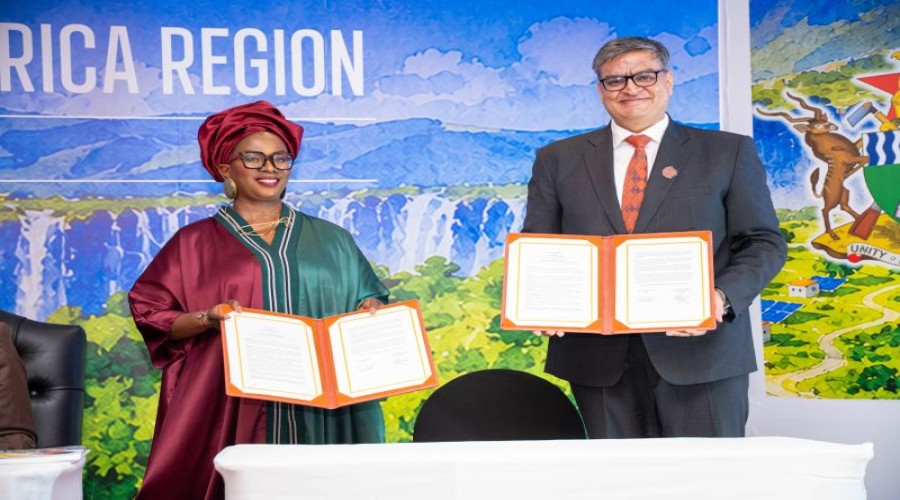
The declaration was signed,
in Victoria Falls at the conclusion of the 8th Meeting of the ISA Regional
Committee for the Africa Region. It was signed by H.E. Lerato D. Mataboge,
Commissioner for Infrastructure and Energy of the African Union Commission, and
Dr Ashish Khanna, Director General of the International Solar Alliance.
The agreement solidifies
cooperation between the two institutions at a time when 48 African countries
are already members of the International Solar Alliance.
The partnership aligns the
ISA’s four pillars of catalytic finance, capability and digitisation, country
engagement, and technology policy with the African Union’s continental energy
architecture. This includes the African Single Electricity Market, the Continental
Power Systems Master Plan and the Solar Energy Policy Framework adopted by
African Heads of State and Government.
The joint agenda will cover
a range of priorities, including mobilising blended finance for solar
investments, developing African manufacturing ecosystems for solar components
and expanding the use of solar technologies in agriculture, healthcare and education.
The partnership will also
focus on strengthening technical skills through the Solar Technology
Application Resource Centres, supporting the development of local capabilities
needed to sustain Africa’s growing solar energy sector.
The two institutions are now
moving from the declaration phase towards implementation, with the African
Union’s Infrastructure and Energy Department expected to work with Member
States and the ISA to prepare bankable solar projects, attract investment and
track implementation outcomes.
The focus will ultimately be
on measurable results, including expanding electricity connections and
increasing the megawatts of solar capacity delivered across African countries.